Battles of the Second World War
1939–1945 · 134 battles covered, in date order. Click a battle on the map for its summary.
Battle (size: ships engaged)
American movement
Japanese movement
British movement
Italian movement
Dutch movement
French movement
German movement
Polish movement
Soviet movement
Routes are approximate.
1939

1–7 September 1939 · Westerplatte, Free City of Danzig
Battle of WesterplatteGerman victory; the depot surrendered after a week
The old battleship Schleswig-Holstein had come to Danzig on a goodwill visit and moored across the harbour from the Polish military depot on the Westerplatte peninsula. At about 4.45 on the morning of 1 September 1939 she opened fire on it at point-blank range, among the first shots of the Second World War. The depot's 200 or so soldiers under Major Henryk Sucharski, expected to hold out for twelve hours, beat off attack after attack by marines, SS troops and police, and held out against her guns, artillery and dive bombers for seven days. They surrendered on 7 September, with 15 killed; the Germans lost many more. Westerplatte became a symbol of Polish resistance.

3 September 1939 · North-west of Ireland
Sinking of AtheniaGerman success; the liner Athenia sunk on the first day of the war
Britain declared war on Germany on the morning of 3 September 1939. That evening, north-west of Ireland, Fritz-Julius Lemp in U-30 sighted the liner Athenia, blacked out and zigzagging, took her for an armed merchant cruiser and fired two torpedoes. She was carrying more than 1,100 passengers to Montreal, among them Jewish refugees and some 300 Americans. She sank the next morning; 117 people died. The destroyers Electra, Escort and Fame and three merchant ships took off the rest. Hitler had ordered liners to be spared. Germany denied the sinking and claimed that Churchill had put a bomb aboard to drag the United States into the war, and the page of U-30's log was rewritten. Britain took it as the start of unrestricted submarine warfare and began sailing ships in convoy at once.
3 (1 lost)
vs
1

3 September 1939 · Hel naval base, Bay of Danzig
Action off HelGerman victory; Wicher and Gryf sunk by bombers after driving off the destroyers
By the third day of the war what was left of the Polish fleet in the Baltic was penned in at Hel, at the tip of its long sandy peninsula. That morning the German destroyers Leberecht Maass and Wolfgang Zenker came in to shell the harbour. The destroyer Wicher and the minelayer Gryf, moored as floating batteries, fired back with the shore guns, and Gryf hit Leberecht Maass twice; the Germans made smoke and drew off. In the afternoon dive bombers came back in force. Wicher was hit four times and sank in the harbour, and Gryf was sunk at her moorings. Their crews went ashore to fight with the garrison, which held Hel until 2 October, the last organised Polish resistance on the coast.
2
vs
2 (2 lost)

14 September 1939 · Western Approaches, north-west of Ireland
Attack on Ark Royal and the sinking of U-39British success; the first U-boat sunk in the war
Ark Royal was hunting U-boats in the Western Approaches with destroyers when, on 14 September 1939, U-39 got into position and fired two torpedoes at her. Both had the new magnetic pistols, which were faulty, and exploded short of the carrier. The destroyers Faulknor, Foxhound and Firedrake turned on the splashes and depth-charged U-39 until she came to the surface, and her whole crew were taken prisoner. She was the first U-boat lost in the war. Three days later U-29 sank Courageous in the same waters, and the carriers were taken off U-boat hunting.
4
vs
1 (1 lost)

17 September 1939 · Western Approaches, south-west of Ireland
Sinking of CourageousGerman success; the carrier Courageous sunk
In the first weeks of the war the Admiralty sent its carriers out with a few destroyers to hunt U-boats in the Western Approaches, a policy dropped after this. On the evening of 17 September 1939 two of Courageous's four destroyers had gone to help a merchant ship under attack when she turned into the wind to land her aircraft, straight across the bows of U-29. Otto Schuhart fired three torpedoes; two hit, and she rolled over and sank in about twenty minutes. 519 men were killed, among them her captain, W. T. Makeig-Jones, who stayed on the bridge. She was the first British warship lost in the war. U-29 got away after four hours of depth charging, and three days earlier Ark Royal had only just escaped the same fate from U-39.
3 (1 lost)
vs
1

14 October 1939 · Scapa Flow, Orkney
Sinking of Royal OakGerman success; Royal Oak sunk at anchor
Scapa Flow, the Home Fleet's anchorage in both wars, was thought safe behind its blockships and booms. In the night of 13–14 October 1939 Günther Prien took U-47 on the surface through a gap beside the blockships in Kirk Sound, at high tide and under the northern lights. Most of the fleet was away; he found the old battleship Royal Oak at anchor in the north-east of the Flow. His first torpedoes did little and the crew thought there had been an internal explosion. Twenty minutes later Prien fired again, and three hits rolled her over in thirteen minutes. 835 men were killed, more than a hundred of them boy sailors under eighteen. U-47 slipped out the way she had come, and Prien came home a hero. The Admiralty closed the eastern sounds with the causeways now called the Churchill Barriers.
1 (1 lost)
vs
1

23 November 1939 · Between Iceland and the Faroes
Sinking of RawalpindiGerman success; Rawalpindi sunk
Scharnhorst and Gneisenau, under Admiral Wilhelm Marschall, sortied to break into the Atlantic and draw British ships away from Graf Spee in the South Atlantic. On the afternoon of 23 November they met the armed merchant cruiser Rawalpindi, an old P&O liner with 6-inch guns, on the Northern Patrol. Captain Edward Kennedy signalled the sighting, refused the order to stop, and fought. Scharnhorst wrecked her in a few minutes; she burned for hours before sinking. 238 men were killed; the Germans picked up 27 and the armed merchant cruiser Chitral eleven more. Fearing the Home Fleet, Marschall turned for home in bad weather and slipped back through the North Sea.
1 (1 lost)
vs
2

4 December 1939 · North Sea, off south-west Norway
Salmon sinks U-36British success; U-36 sunk with all hands
On patrol off the Norwegian coast on 4 December 1939, the submarine Salmon sighted U-36 on the surface, heading out into the North Sea. Lieutenant-Commander Edward Bickford fired a salvo of torpedoes; one hit, and U-36 sank with all hands. It was the first time in the war that one submarine had sunk another. Nine days later Salmon torpedoed the cruisers Leipzig and Nürnberg.
1
vs
1 (1 lost)
13 December 1939 · North Sea, west of Heligoland
Salmon torpedoes Leipzig and NürnbergBritish success; two German cruisers torpedoed
On 13 December 1939 the light cruisers Leipzig, Nürnberg and Köln sailed to meet German destroyers coming home from laying mines off the Tyne. The submarine Salmon, under Lieutenant-Commander Edward Bickford, which had sunk U-36 nine days earlier, sighted them and fired a full salvo of six torpedoes at long range. One hit Nürnberg forward and another hit Leipzig amidships. Both cruisers reached the Elbe, but Leipzig was out of action for a year, and afterwards was used mostly for training. The day before, Salmon had let the liner Bremen pass unharmed, as the rules of war then required.
1
vs
3

13–17 December 1939 · Off the estuary of the River Plate, Uruguay
Battle of the River PlateBritish victory; Graf Spee took refuge at Montevideo and was scuttled
Graf Spee had sunk nine merchant ships in the South Atlantic and the Indian Ocean since the war began. Commodore Henry Harwood guessed that she would come for the rich shipping off the River Plate, and was waiting there with the heavy cruiser Exeter and the light cruisers Ajax and Achilles when she appeared at dawn on 13 December 1939. Captain Hans Langsdorff closed, thinking at first that he faced a cruiser and two destroyers. Harwood split his ships so that she had to divide her fire. Her 11-inch guns wrecked Exeter, putting all three of her turrets out of action and killing 61 men, and knocked out two of Ajax's turrets. But Graf Spee was hit about twenty times, 36 of her crew were dead and her fuel plant was damaged, and Langsdorff broke away into Montevideo. Uruguay gave him 72 hours. British diplomacy and false radio traffic convinced him that Ark Royal and Renown were waiting outside; in fact only Cumberland had arrived. On the evening of 17 December he took Graf Spee out to the edge of the estuary and scuttled her in front of a crowd of thousands. Three days later he shot himself in Buenos Aires.
4
vs
1 (1 lost)
1940

16 February 1940 · Jøssingfjord, south-western Norway
Altmark incidentBritish success; 299 prisoners freed in Norwegian waters
Graf Spee's supply ship Altmark was taking 299 British merchant seamen, taken from the ships Graf Spee had sunk, home to Germany through Norway's neutral coastal waters. Norwegian torpedo boats had looked her over and let her pass. When British aircraft found her, Captain Philip Vian took Cossack into the Jøssingfjord, where Altmark had run for shelter, came alongside after she tried to ram him, and sent a boarding party across. Seven Germans were killed in the fight on deck. The prisoners were found in the holds, and a boarder's shout of "The Navy's here!" became famous. Norway protested at the breach of its neutrality; in Berlin the incident helped convince Hitler that Britain would not respect it, and planning for the invasion of Norway was speeded up.
6
vs
1
vs
2

22 February 1940 · Dogger Bank, North Sea
Operation WikingerGerman disaster; two destroyers lost to their own aircraft and mines
Six German destroyers sailed to catch British fishing boats on the Dogger Bank, thought to be reporting U-boat movements. Neither the navy nor the Luftwaffe had told the other what it was doing. In the evening a Heinkel He 111 of KG 26, hunting British ships, bombed Leberecht Maass, which broke apart and sank. Max Schultz, coming to help, sank too, probably on mines laid by British destroyers in January, though at the time it was thought another bomb. Nearly 600 men died; 60 were saved, all from Leberecht Maass. A German inquiry blamed poor liaison between the services, and the operation was called off.
6 (2 lost)

8 April 1940 · Norwegian Sea, north-west of Trondheim
Action of 8 April 1940German victory; Glowworm sunk after ramming Admiral Hipper
The day before the invasion of Norway, the destroyer Glowworm had dropped behind Renown's force in a gale to look for a man washed overboard. In the morning she ran into German destroyers carrying troops for Trondheim and fought Bernd von Arnim, then Admiral Hipper came up. Lieutenant-Commander Gerard Roope laid smoke, fired his torpedoes, missed, and with his ship on fire turned and rammed the cruiser, tearing away 40 metres of her armour belt and her starboard torpedo tubes. Glowworm blew up soon after. Hipper stopped to pick up 40 survivors; Roope drowned as he was being hauled aboard. Her report was one of the first signs that a German invasion force was at sea. Roope's Victoria Cross was given after the war on the recommendation of Hipper's captain.
1 (1 lost)
vs
2

9 April 1940 · Off the Lofoten Islands and the mouth of the Vestfjord
Action off LofotenIndecisive; Gneisenau damaged, the German battleships escaped north
Having left the destroyers for Narvik at the mouth of the Vestfjord, Scharnhorst and Gneisenau under Admiral Günther Lütjens were covering them at sea when Admiral Whitworth's Renown found them in a snowstorm before dawn on 9 April. Renown's 15-inch guns hit Gneisenau three times, knocking out her main fire control and a forward turret; Renown was hit twice, without serious damage. Lütjens turned away north-east into heavy seas, where Renown, a single old battlecruiser, could not keep up, and the Germans escaped. It was the first time a British capital ship had fired on a German one since 1918, and the only time in the war a battlecruiser fought two fast battleships.
10
vs
2

9 April 1940 · Drøbak Narrows, Oslofjord
Battle of Drøbak SoundNorwegian victory; Blücher sunk and the landing at Oslo delayed
The force sent to take Oslo on the first morning of the invasion, led by the new heavy cruiser Blücher under Rear-Admiral Oskar Kummetz and carrying the staff that was to run occupied Norway, steamed up the Oslofjord in the dark. At the Drøbak Narrows, Colonel Birger Eriksen of the Oscarsborg fortress, with no orders and no news of a war, opened fire at close range with his two 28-cm guns, built in 1893 and nicknamed Moses and Aron. Smaller guns at Kopås joined in, then two old torpedoes from the hidden battery on Nordre Kaholmen hit her. Blücher capsized and sank in the narrows; perhaps 600 to 800 men died. The rest of the force turned back and landed its troops down the fjord, and Oslo fell only that afternoon, to troops flown in. The delay let King Haakon, the government and the gold reserves get away from the capital, and Norway fought on.
8 (1 lost)

9–10 April 1940 · Bergen, Norway
Sinking of KönigsbergBritish success; Königsberg sunk by dive bombers
Königsberg and Köln landed troops at Bergen on the morning of the invasion. The guns of the Kvarven fortress hit Königsberg three times as she came in, and she was left alongside the quay to be repaired while Köln sailed for home. At dawn on 10 April sixteen Blackburn Skuas of 800 and 803 Naval Air Squadrons, flying from Hatston in Orkney at the limit of their range, dived on her. Three bombs hit; she caught fire, rolled over and sank. She was the first major warship ever sunk by air attack in war.
3 (1 lost)

9 April 1940 · Off Kristiansand, Skagerrak
Sinking of KarlsruheBritish success; Karlsruhe torpedoed and scuttled
Karlsruhe led the group that took Kristiansand. The Odderøya fortress held her off twice in fog that morning before the town was taken. Sailing for home that evening, she was hit by a torpedo from the submarine Truant, which flooded her engine rooms. Her crew were taken off by the torpedo boats, and Greif sank her with two more torpedoes. Truant was hunted with depth charges for hours but got away.
1
vs
4 (1 lost)

9 April 1940 · Narvik harbour and the Ofotfjord
German landing at NarvikGerman victory; Eidsvold and Norge sunk and Narvik taken
Ten German destroyers under Commodore Friedrich Bonte carried 2,000 mountain troops under General Eduard Dietl to Narvik, the port for the Swedish iron ore. They came up the Ofotfjord in a snowstorm before dawn. The old coast-defence ship Eidsvold fired a warning shot; a German officer went across to demand surrender, and when Captain Willoch refused, Wilhelm Heidkamp torpedoed her as the boat came back. She broke in two and sank in seconds. In the harbour Norge opened fire, missing in the snow, and Bernd von Arnim sank her with torpedoes. 276 Norwegian sailors died; the garrison's commander surrendered the town.
10
vs
2 (2 lost)

9 April 1940 · Trondheimsfjord, Norway
Landing at TrondheimGerman success; Trondheim taken without a fight
Group 2 of the invasion of Norway, Admiral Hipper and four destroyers with about 1,700 mountain troops, had met Glowworm on the way north the day before. In the dark early on 9 April 1940 they ran into the Trondheimsfjord at 25 knots, answering the forts' challenges in English. The Agdenes batteries guarding the narrows opened fire too late and missed; Hipper fired back as she passed. The ships anchored off Trondheim at about 05:25 and landed their troops, who took the city without a fight and captured the forts from behind. The destroyers had almost no fuel left and were stuck for days, and when Hipper tried to slip home on 10 April, Friedrich Eckoldt could not keep up in the heavy seas and had to turn back.

10 April 1940 · Narvik harbour and the Ofotfjord
First Battle of NarvikIndecisive; two destroyers lost on each side, the Germans trapped in Narvik
Told the Germans held Narvik with perhaps one ship, Captain Bernard Warburton-Lee signalled "Intend attacking at dawn high water" and took five H-class destroyers up the fjord in falling snow. They caught five German destroyers in the harbour refuelling. Torpedoes sank Wilhelm Heidkamp, killing Commodore Bonte, and broke Anton Schmitt in two, damaged Diether von Roeder and Hans Lüdemann, and sank merchant ships. But the other five German destroyers were in the side fjords. As the British withdrew, three came out of the Herjangsfjord and two from Ballangen to catch them between. A shell burst on Hardy's bridge; she was run ashore and Warburton-Lee died. Hunter was hit and then rammed by Hotspur and sank. Havock, Hostile and the damaged Hotspur got out, sinking the German ammunition ship Rauenfels on the way. Warburton-Lee was given the Victoria Cross. The German destroyers, short of fuel and ammunition, could not leave.
5 (2 lost)
vs
10 (2 lost)
11 April 1940 · Skagerrak, north of Skagen
Spearfish torpedoes LützowBritish success; Lützow crippled
Lützow, until a few months before the Deutschland, had been hit by the Oscarsborg guns at Drøbak, and was ordered home to be repaired before an Atlantic raid. Crossing the Skagerrak at speed in the dark early on 11 April 1940, she passed the submarine Spearfish, on the surface charging her batteries. Lieutenant-Commander John Forbes fired a full salvo. One torpedo hit right aft, blowing away her propellers and rudder and nearly tearing off her stern; 15 men were killed. She drifted helpless towards the Danish coast until tugs towed her to Kiel, and she was out of action for a year.
1
vs
1

13 April 1940 · Ofotfjord, Herjangsfjord and Rombaksfjord, near Narvik
Second Battle of NarvikBritish victory; all eight German destroyers and a U-boat destroyed
Three days later the British came back in strength. Vice-Admiral Whitworth took the battleship Warspite up the Ofotfjord with nine destroyers. Warspite's Swordfish floatplane, scouting ahead, found U-64 at anchor in the Herjangsfjord and sank her with bombs, the first U-boat sunk by an aircraft in the war, and reported the German destroyers waiting in ambush. One by one they were found and sunk or driven ashore: Erich Koellner, lying as a floating battery, was the first; Warspite's 15-inch guns echoing round the mountains finished several more. The last four, out of ammunition, fled up the narrow Rombaksfjord, where Georg Thiele blew Eskimo's bow off with her last torpedo before running herself ashore, and the others were scuttled. Their 2,600 sailors went ashore to fight beside Dietl's troops. With the Narvik destroyers and the losses of 9–10 April, Germany had lost half of its destroyers in a week.
10
vs
9 (9 lost)

8 June 1940 · Norwegian Sea, west of Narvik
Sinking of GloriousGerman victory; Glorious, Ardent and Acasta sunk
As the Allies evacuated northern Norway, the carrier Glorious sailed ahead for Scapa Flow with only the destroyers Ardent and Acasta, carrying the RAF Hurricanes and Gladiators that had been landed on her deck. Her captain, Guy D'Oyly-Hughes, had no aircraft in the air and no lookout in her crow's nest. Admiral Marschall, out with Scharnhorst and Gneisenau in Operation Juno, sighted her smoke. Scharnhorst hit her at 24,000 yards with one of the longest-range hits ever made at sea, wrecking her flight deck before she could launch her Swordfish. Both destroyers attacked through their own smoke. Ardent was sunk, but Acasta, sinking, hit Scharnhorst with a torpedo that killed 48 men and flooded her engine rooms, and Marschall broke off for Trondheim. Glorious capsized and sank. About 1,500 men were lost, more than in Hood; most survived the sinking but died in the water over the next two days.
3 (3 lost)
vs
2

8 June 1940 · Norwegian Sea, off Narvik
Operation JunoGerman success; a troopship, a tanker and a trawler sunk
Admiral Wilhelm Marschall sailed from Kiel with Scharnhorst, Gneisenau, Admiral Hipper and four destroyers to attack the British base at Harstad and help the German troops cut off at Narvik. He did not know that the Allies were already leaving Norway. On 8 June 1940 the force found and sank the tanker Oil Pioneer and the anti-submarine trawler Juniper, and then the empty troopship Orama, sailing home on her own; Hans Lody finished off Orama and Oil Pioneer, and nearly 300 of Orama's people were taken prisoner. The hospital ship Atlantis was left alone. Marschall then sent Hipper and the destroyers into Trondheim to refuel and went on with the two battleships, which that afternoon found the carrier Glorious.
3 (3 lost)
vs
7
20 June 1940 · Norwegian Sea, off the Halten Bank
Clyde torpedoes GneisenauBritish success; Gneisenau torpedoed
Scharnhorst, holed by Acasta's torpedo, had been patched up at Trondheim and was to be sent home. To draw the British away, Gneisenau and Admiral Hipper sailed from Trondheim on 20 June 1940 as if heading for Iceland. That night, off the Halten Bank, the submarine Clyde hit Gneisenau in the bow with a torpedo, tearing a large hole in both sides. She turned back to Trondheim, and went home to Kiel for repairs that lasted until the end of the year.
1
vs
2

3 July 1940 · Mers-el-Kébir, near Oran, French Algeria
Attack on Mers-el-KébirBritish success; one French battleship sunk, two damaged
After France's surrender Churchill would not risk the French fleet falling into German hands. Vice-Admiral Somerville's Force H arrived off Mers-el-Kébir and gave Admiral Gensoul a choice: sail to British or American ports, demilitarise his ships, or scuttle them. Talks through Captain Cedric Holland lasted most of the day. At 5.54 in the evening the British opened fire on the French squadron, moored with their sterns to the mole and their guns pointing the wrong way. In ten minutes a 15-inch shell set off Bretagne's magazine and she capsized, Dunkerque and Provence were hit and run aground, and the destroyer Mogador lost her stern. Strasbourg got out of the harbour with five destroyers and, chased by Hood and Ark Royal's Swordfish, reached Toulon. Three days later Swordfish came back to torpedo the stranded Dunkerque. In all 1,297 French sailors were killed. Vichy France broke off relations with Britain, but the attack showed the world that Britain meant to fight on.
17
vs
11 (1 lost)

9 July 1940 · Off Punta Stilo, Calabria, Italy
Battle of CalabriaInconclusive; the Italian fleet withdrew
The first fleet action of the war in the Mediterranean, called the Battle of Punta Stilo by the Italians. Both fleets were at sea covering convoys, Admiral Cunningham's to Alexandria from Malta and Admiral Campioni's to Benghazi. Cunningham steered to get between the Italians and their base at Taranto. In the afternoon the cruisers met, then the battleships: Warspite engaged Giulio Cesare, and at about thirteen miles hit her amidships with a 15-inch shell, one of the longest-range hits ever made on a moving target. Four of Cesare's boilers were knocked out and her speed fell to 18 knots. Campioni turned away behind smoke, and his destroyers made torpedo attacks to cover him. Italian bombers attacked both fleets for hours without hitting anything, and Cunningham broke off within 25 miles of the Italian coast. No ship was sunk, but the Regia Marina avoided a full fleet action for the rest of the year.
25
vs
3

19 July 1940 · Off Cape Spada, north-west Crete
Battle of Cape SpadaBritish victory; Bartolomeo Colleoni sunk
Two fast Italian light cruisers under Admiral Casardi, sent to raid shipping in the Aegean, ran into four British destroyers sweeping for submarines north of Crete. The destroyers fell back towards HMAS Sydney, which Captain John Collins had brought up against orders. Sydney came out of the haze and hit Bartolomeo Colleoni, whose thin armour could not stop a 6-inch shell; one in her engine room stopped her dead. The destroyers finished her with torpedoes and picked up 525 of her crew. Sydney chased Giovanni delle Bande Nere south-west until she was almost out of ammunition, and was hit once herself, in the funnel. Collins was made a CB, and the battle confirmed the Mediterranean Fleet's belief that it had the measure of the Italian navy.
6
vs
2 (1 lost)

28 July 1940 · South Atlantic, near Trindade
Action between Thor and AlcantaraInconclusive; both ships damaged and Thor escaped
The disguised raider Thor, under Otto Kähler, had already taken or sunk six ships in the South Atlantic when the armed merchant cruiser Alcantara, an old Royal Mail liner, came on her near the island of Trindade on 28 July 1940. Alcantara was faster, so Kähler turned to fight. Thor's guns were better controlled: three early hits, one on the waterline, flooded Alcantara's engine room and cut her speed. Alcantara hit Thor twice, one shell passing through her hull without exploding. Thor laid smoke and got away, and changed her disguise. It was the first of three fights between Thor and armed merchant cruisers.
1
vs
1
1 August 1940 · North Sea, west of southern Norway
Sinking of SpearfishGerman success; Spearfish sunk
Spearfish, which had crippled Lützow in April, was crossing the North Sea on the surface to patrol off Norway when U-34 sighted her on 1 August 1940 and hit her with a torpedo. She sank at once. U-34 picked up the only survivor, Able Seaman William Pester, who spent the rest of the war as a prisoner. U-34 was coming home from a patrol in which she had sunk the destroyer Whirlwind and several merchant ships.
1 (1 lost)
vs
1

16–19 October 1940 · Western Approaches, west of the Hebrides
Convoy SC 7German victory; 20 of 35 merchant ships sunk without loss
SC 7 was a slow convoy of 35 mostly elderly merchant ships from Sydney, Nova Scotia, with a single sloop as escort for most of the crossing. From 16 October 1940 a pack of U-boats, directed by radio from France, gathered on it west of the Hebrides. Two more sloops and two corvettes came out to meet it, but they had never worked together, had no radar and no plan, and kept dropping back to pick up survivors. On the night of 18–19 October the U-boats attacked on the surface and at night, slipping inside the convoy where the escorts' ASDIC could not find them. Otto Kretschmer in U-99 sank more ships than any other boat. Twenty of the 35 ships were sunk and two damaged, and no U-boat was lost. The next night the same boats fell on convoy HX 79. The two nights showed that escorts had to be trained to fight together as groups.
40 (20 lost)
vs
8
19–20 October 1940 · Western Approaches, west of Ireland
Convoy HX 79German victory; 12 of 49 merchant ships sunk without loss
HX 79, 49 ships from Halifax, came into the Western Approaches on 19 October 1940 while the U-boats that had wrecked SC 7 were still close by. It had a stronger escort than SC 7, two destroyers, four corvettes and three trawlers, but the ships had joined one by one, the corvettes were new, and nobody had trained together. Günther Prien in U-47, out of torpedoes but for a few, shadowed the convoy and called in the others. That night five U-boats sank 12 ships and damaged a tanker; none of them was lost. In three nights SC 7 and HX 79 lost 32 ships, the worst run of the war in the Atlantic. The Admiralty's answer was permanent escort groups that trained and sailed together, and radio telephones between the escorts.
58 (12 lost)
vs
5

26–28 October 1940 · North-west of Ireland
Sinking of Empress of BritainGerman success; the largest ship sunk by a U-boat
The liner Empress of Britain, carrying troops' families and servicemen home from the Middle East round the Cape, was nearly home on 26 October 1940 when a Focke-Wulf Condor long-range bomber, flown by Bernhard Jope, hit her with two bombs off north-west Ireland and set her ablaze. About 45 people were killed and the rest were taken off. Tugs took the burning hulk in tow with destroyers in escort, but early on 28 October Hans Jenisch in U-32 found her and hit her with two torpedoes, and she sank. At 42,348 tons she was the largest ship sunk by a U-boat in the war. Two days later U-32 was sunk by the destroyers Harvester and Highlander, and Jenisch was taken prisoner.
1 (1 lost)
vs
1

5 November 1940 · North Atlantic, south of Greenland
Convoy HX 84 and Jervis BayGerman success, but most of the convoy escaped; Jervis Bay sunk
Admiral Scheer broke out into the Atlantic through the Denmark Strait, and on 5 November 1940 her seaplane found convoy HX 84, 37 ships from Halifax with only the armed merchant cruiser Jervis Bay to escort them. Captain Edward Fegen ordered the convoy to scatter and steered his old liner straight at the raider, firing 6-inch guns that could not reach her. She was wrecked in 22 minutes and sank with 190 of her crew, Fegen among them; the Swedish Stureholm went back after dark and picked up 65 survivors. The time she bought and the falling dark let most of the convoy escape. Scheer caught and sank five ships, among them Beaverford, which fought her alone with two guns for several hours. The tanker San Demetrio was set on fire and abandoned; days later some of her crew found her still afloat, reboarded her and brought her home. Fegen was given a posthumous Victoria Cross, and the Atlantic convoys were held in port for twelve days while the Home Fleet hunted for Scheer.
38 (6 lost)
vs
1

11–12 November 1940 · Taranto harbour, Italy
Battle of TarantoBritish victory; three Italian battleships put out of action
The first attack on a fleet in harbour by carrier aircraft alone. Illustrious flew off 21 Swordfish biplanes about 170 miles from Taranto, in two waves an hour apart, five of them from Eagle, which had been kept back by defects. Flares and bombs lit up the harbour and distracted the gunners while the torpedo bombers came in low, between the barrage balloons and over the anti-torpedo nets, which reached only part of the way down. Littorio was hit by three torpedoes, Caio Duilio and Conte di Cavour by one each; Cavour sank in the harbour and never sailed again. Two Swordfish were shot down and two men killed. In one night half the Italian battle fleet was out of action, and the rest was moved to Naples. Japanese naval officers studied the attack closely before Pearl Harbor.
1
vs
7 (1 lost)

27 November 1940 · South of Sardinia
Battle of Cape SpartiventoInconclusive; both sides withdrew
The Italians call it the Battle of Cape Teulada. Admiral Campioni sailed with Vittorio Veneto and Giulio Cesare to catch Force H while it was escorting a convoy for Malta and Alexandria. Somerville, joined by Ramillies from the east, turned to attack. The cruisers fought a running gunnery action at long range for about an hour: Berwick was hit twice and the Italian destroyer Lanciere crippled. Vittorio Veneto fired a few salvoes at the British cruisers, and Ark Royal's Swordfish attacked her without scoring. Campioni, who had orders not to risk his fleet against equal forces, withdrew towards Naples; Somerville, with the convoy to protect and the Sardinian coast close, gave up the chase. A board of inquiry was sent from London to examine his conduct, and cleared him.
9
vs
9

29 November 1940 · English Channel, off Plymouth
Action off PlymouthGerman success; Javelin crippled
From Brest, the German 5th Destroyer Flotilla raided the Channel in the autumn of 1940, laying mines and attacking coastal shipping. Hans Lody, Richard Beitzen and Karl Galster had sunk a tug and a barge off the Cornish coast when, at dawn on 29 November, they were caught by the 5th Destroyer Flotilla under Captain Lord Louis Mountbatten in Javelin, with Jupiter, Jackal, Jersey and Kashmir. The Germans fired their torpedoes and turned for home. Two from Hans Lody hit Javelin, blowing off her bow and stern; 45 of her crew were killed. The Germans escaped to Brest. Javelin, with only 155 feet of her hull left, was towed into Plymouth and spent almost a year being rebuilt.
5
vs
3

5 December 1940 · South Atlantic, off southern Brazil
Action between Thor and Carnarvon CastleGerman success; Carnarvon Castle damaged and driven off
On 5 December 1940 the armed merchant cruiser Carnarvon Castle met the raider Thor off Brazil. They fought a running gun duel for about an hour at seven to eight thousand yards, both firing torpedoes that missed. Thor's guns hit the liner eight times, killing six men and wounding 32, and some of her own guns jammed from overheating, but she was not hit. Carnarvon Castle broke off and went into Montevideo for repairs, where, it was said, steel from the wreck of Graf Spee was used to patch her.
1
vs
1

6–27 December 1940 · Nauru, central Pacific
Attacks on NauruGerman success; five phosphate ships sunk and the loading plant shelled
The raiders Orion and Komet, with the supply ship Kulmerland, joined forces in the Pacific in late 1940. Komet had come round the north of Siberia with Soviet icebreakers. Nauru's phosphate fed the farms of Australia and New Zealand, and ships waited off the island to load it. Between 6 and 8 December the raiders sank five of them, Triona, Vinni, Komata, Triadic and Triaster, and took more than 500 prisoners, most of whom they landed on Emirau Island. Bad weather stopped a landing on Nauru itself. On 27 December Komet came back alone and shelled the loading plant, oil tanks and mooring buoys for about an hour. It was the most damaging German raid in Australian waters, and led to convoys and a garrison for the phosphate islands.
5 (5 lost)
vs
3
25 December 1940 · North Atlantic, west of Cape Finisterre
Convoy WS 5ABritish success; Admiral Hipper driven off the troop convoy
Admiral Hipper, out on her first Atlantic raid, found troop convoy WS 5A by radar 700 miles west of Cape Finisterre on Christmas Eve 1940. She had expected a merchant convoy, but WS 5A was carrying soldiers round the Cape to the Middle East, with the heavy cruiser Berwick, the light cruisers Bonaventure and Dunedin and two carriers ferrying aircraft. At dawn on Christmas Day, in rain and poor visibility, she opened fire. Berwick engaged her and was hit four times, on her after turrets and at the waterline, and the troopship Empire Trooper was damaged. Hipper, short of fuel and with engine trouble, broke away. She sank a lone merchant ship, Jumna, on her way to Brest, where she arrived two days later: the first big German warship to use a French Atlantic port.
3
vs
1
1941
12 February 1941 · North Atlantic, east of the Azores
Convoy SLS 64German victory; seven merchant ships sunk
Admiral Hipper sailed from Brest again on 1 February 1941. On 11 February she sank a straggler, and at dawn the next day came on convoy SLS 64, 19 slow ships from Freetown that had no warship escort. Passing herself off as a British cruiser until she was close, she opened fire and in an hour sank seven ships and damaged two more before the rest scattered. She was back in Brest on 15 February. Her engines were giving so much trouble that in March she went home to Germany through the Denmark Strait.
19 (7 lost)
vs
1
15–17 March 1941 · Western Approaches, south-east of Iceland
Convoy HX 112British victory; U-99 and U-100 sunk for the loss of six ships
HX 112, 41 ships from Halifax, was found south of Iceland on 15 March 1941 by Fritz-Julius Lemp in U-110, who called in other boats. Its escort was the new 5th Escort Group under Commander Donald Macintyre in Walker. On the night of 16 March Otto Kretschmer took U-99 into the convoy on the surface and sank five ships in an hour. But the escorts had now trained together. Walker drove Joachim Schepke's U-100 deep with depth charges; when she came up, Vanoc found her by radar in the dark, the first time a ship's radar found a U-boat, and rammed her. Schepke was crushed on his bridge. Minutes later U-99, out of torpedoes and diving to avoid Walker, was picked up on Walker's ASDIC and depth-charged to the surface. Kretschmer, the most successful U-boat commander of the war, scuttled her and was taken prisoner with most of his crew. With Prien's U-47 lost a week earlier, Germany's three best-known U-boat commanders were gone in a fortnight.
48 (6 lost)
vs
5 (2 lost)

27–29 March 1941 · South of Cape Matapan, Greece
Battle of Cape MatapanBritish victory; three Italian heavy cruisers and two destroyers sunk
Pressed by the Germans to attack the convoys carrying British troops to Greece, Admiral Iachino took Vittorio Veneto and eight cruisers into the waters south of Crete. Cunningham knew they were coming from codebreakers at Bletchley Park and sailed from Alexandria after dark, having gone ashore that afternoon with his golf clubs to fool the Japanese consul. On the morning of 28 March the Italian cruisers chased Pridham-Wippell's light cruisers towards Vittorio Veneto's guns, and only an attack by Formidable's torpedo planes got them out of trouble. In the afternoon an Albacore torpedoed Vittorio Veneto; her pilot was killed, but she was stopped for a time and slowed for the rest of the day. At dusk another torpedo stopped the heavy cruiser Pola. Iachino, not knowing the British battleships were close, sent Admiral Cattaneo back for her with Zara, Fiume and four destroyers. Valiant's radar found them in the dark, and at 10.27 pm Warspite, Valiant and Barham opened fire at under two miles with searchlights. Zara and Fiume were wrecked in minutes, their guns still trained fore and aft. The destroyers Alfieri and Carducci were sunk, and Pola was boarded and then torpedoed. About 2,300 Italian sailors were killed, Cattaneo among them. The British lost one aircraft. Vittorio Veneto got home, but the Italian fleet did not come so far east again.
11
vs
13 (5 lost)
4 April 1941 · Central Atlantic, west of the Cape Verde Islands
Sinking of VoltaireGerman victory; Voltaire sunk
On the morning of 4 April 1941 Thor, now on her way home, met the armed merchant cruiser Voltaire, an old Lamport & Holt liner, west of the Cape Verde Islands. Thor's first salvo hit Voltaire's generator and wireless office, so she could not report the fight, and set her on fire. Her old guns overheated and her steering jammed, and after about an hour she struck her flag, burning from end to end. Thor picked up 197 men; 75 were killed. It was the third armed merchant cruiser Thor had fought, and the only one she sank. She reached Hamburg at the end of the month after 329 days at sea.
1 (1 lost)
vs
1

6 April 1941 · Brest harbour, France
Beaufort attack on GneisenauBritish success; Gneisenau torpedoed in harbour
Scharnhorst and Gneisenau came into Brest from their Atlantic raid in March 1941, and the RAF set out to cripple them there. Gneisenau was moved out of dry dock into the harbour because of an unexploded bomb, and at dawn on 6 April four Beaufort torpedo bombers of 22 Squadron were sent against her. Only Flying Officer Kenneth Campbell found her in the murk. He flew in low over the mole, through the fire of hundreds of guns on the hills around the harbour and the flak ships, and dropped his torpedo at point-blank range. It hit Gneisenau's stern below the waterline and flooded her engine rooms. The Beaufort was shot down a moment later and its crew of four killed; the Germans buried them with honours. Campbell was given a posthumous Victoria Cross. Four nights later RAF bombs hit Gneisenau again in dry dock, and she was out of action until the end of the year.

7–10 May 1941 · North Atlantic, south of Iceland and east of Cape Farewell
Convoy OB 318 and the capture of U-110British success; U-110 captured with her Enigma machine and code books
U-boats found outbound convoy OB 318 south of Iceland on 7 May 1941 and sank seven ships in four days. On 9 May Fritz-Julius Lemp in U-110 torpedoed two ships, but the corvette Aubrietia picked up his periscope on her ASDIC, and her depth charges, with the destroyers Broadway and Bulldog, forced U-110 to the surface. Bulldog turned to ram, and Lemp's crew abandoned ship, thinking she would sink. Commander Joe Baker-Cresswell turned away instead and sent a boarding party under Sub-Lieutenant David Balme, which brought out her Enigma machine, its settings and her code books. Lemp, swimming back to destroy them, was never seen again. U-110 sank under tow two days later, which helped keep the capture secret: her crew were kept apart from other prisoners and never knew. The papers helped Bletchley Park read the U-boat cipher for months afterwards.
3
vs
4 (1 lost)

8 May 1941 · Indian Ocean, north of the Seychelles
Sinking of PinguinBritish victory; Pinguin sunk
Pinguin, under Ernst-Felix Krüder, had sunk or captured about thirty ships, among them almost the whole Norwegian whaling fleet in the Antarctic. On 7 May 1941 she sank the tanker British Emperor, which got off a raider report, and the next morning the cruiser Cornwall found her. Krüder claimed to be the Norwegian Tamerlane and ran, while Cornwall closed to check. When Cornwall fired a warning shot he dropped his disguise and opened fire, hitting the cruiser and briefly knocking out her steering. Cornwall's 8-inch salvoes hit the mines Pinguin carried, and she blew up. More than 500 people died, among them some 200 British and Indian prisoners. Cornwall picked up 60 Germans and 22 prisoners.
1
vs
1 (1 lost)

20 May – 1 June 1941 · Around Crete, Greece
Battle of CreteGerman victory; three British cruisers and six destroyers sunk
When German paratroops landed on Crete, the Mediterranean Fleet's task was to stop any invasion by sea, and later to take off the army. On the nights of 21 and 22 May British cruisers and destroyers broke up two convoys of caiques carrying German troops; the Italian torpedo boat Lupo fought off a whole cruiser force to cover the first. But by day the ships were within easy range of German dive bombers flying from Greece. Juno was sunk on the 21st; on the 22nd Greyhound, Gloucester and Fiji, and Warspite and Valiant were hit. Kelly and Kashmir were sunk the next morning. Formidable was badly damaged on the 26th trying to strike back at the airfields. On 28 May the army was ordered to leave; the navy took off about 16,500 men over four nights, losing Imperial, Hereward and Calcutta, while Orion and Dido were hit with troops crowded on their decks. Cunningham refused to stop the evacuation, saying it took three years to build a ship but three hundred to build a tradition. About 2,000 sailors were killed, and the fleet was left with two battleships and three cruisers fit for sea.
21 (9 lost)
vs
2

24 May 1941 · Denmark Strait, between Greenland and Iceland
Battle of the Denmark StraitGerman victory; Hood sunk, Prince of Wales driven off, Bismarck damaged
Admiral Günther Lütjens took Bismarck and Prinz Eugen out of the Baltic to raid the Atlantic convoys. Spotted in a Norwegian fjord near Bergen, they ran for the Denmark Strait, where the cruisers Suffolk and Norfolk found them in the evening of 23 May and held on to them by radar through the night. Vice-Admiral Lancelot Holland, coming up with Hood and the new Prince of Wales, met them at dawn. He turned towards them to close the range quickly, so that only his forward guns could fire, and both ships at first fired on Prinz Eugen, thinking her Bismarck. At 6 a.m., eight minutes after the first salvo, a shell from Bismarck's fifth salvo set off Hood's after magazines. She broke in two and sank in three minutes. Of 1,418 men, three survived. Prince of Wales, hit seven times with her guns jamming and builders' men still aboard, turned away under smoke. But she had hit Bismarck three times, and one shell holed a forward fuel tank; leaking oil, Bismarck could not raid the convoys, and Lütjens made for St Nazaire, while Prinz Eugen went on alone.
5 (1 lost)
vs
2

24 May 1941 · North Atlantic, south-east of Cape Farewell
Victorious's air attack on BismarckOne hit, no lasting damage
Tovey sent the new carrier Victorious ahead to slow Bismarck down. Her aircrews had only just joined. Near midnight on 24 May nine Swordfish of 825 Squadron, led by Lieutenant-Commander Eugene Esmonde, flew 120 miles through rain and found Bismarck by radar. One torpedo hit her armour belt amidships and killed a man, the first death aboard; the shock loosened the patches over her earlier damage. All the Swordfish got back to the carrier in the dark, though few of the pilots had landed on a deck at night. A few hours later Bismarck turned away and Suffolk lost her; for more than a day the British did not know where she was.
4
vs
1

26 May 1941 · North Atlantic, west of Brest
Ark Royal's air attack on BismarckBritish success; Bismarck's rudders jammed
On the morning of 26 May a Catalina of Coastal Command found Bismarck again, 700 miles from Brest and too far ahead for Tovey's battleships to catch. Only Force H, coming up from Gibraltar, stood in her way. Ark Royal's first strike of Swordfish, flying through gales, attacked the cruiser Sheffield by mistake; luckily their magnetic pistols set the torpedoes off early, and Sheffield dodged the rest. With contact pistols, fifteen Swordfish attacked Bismarck at dusk. Two or three torpedoes hit, and one, right aft, jammed her rudders hard over. She could steam only in a slow circle into the wind, towards Tovey. That night Lütjens signalled Berlin: "Ship unmanoeuvrable. We shall fight to the last shell."
3
vs
1

26–27 May 1941 · North Atlantic, west of Brest
Vian's night attacks on BismarckNo hits; Bismarck kept awake and under watch through the night
Captain Philip Vian, sent from a troop convoy with five destroyers, found the crippled Bismarck in the dark and squalls late on 26 May. The Polish Piorun saw her first and closed to engage her alone, signalling "I am a Pole". Through the night the destroyers came in again and again to fire torpedoes by starshell, while Bismarck's radar-directed guns straddled them. No torpedo is known to have hit, but they kept her crew at action stations all night and reported her position to Tovey until dawn.
5
vs
1

27 May 1941 · North Atlantic, about 300 miles west of Brest
Sinking of BismarckBritish victory; Bismarck sunk
At 8.47 in the morning, with a gale blowing from the north-west, Rodney and King George V opened fire. Bismarck, still unable to steer, hit back for a while, but her fire-control top and forward turrets were knocked out within half an hour. Rodney closed to 3,000 yards and fired her 16-inch guns almost point-blank, and fired a torpedo; Norfolk and Dorsetshire joined in. By ten o'clock Bismarck was a blazing wreck with her guns silent and her flag still flying. Short of fuel, Tovey took the battleships home and left Dorsetshire to torpedo her. Bismarck rolled over and sank at 10.39, perhaps helped by scuttling charges set by her crew. Dorsetshire and Maori had picked up about 110 men when a U-boat alarm made them leave; a U-boat and a German weather ship rescued five more. More than 2,000 died, Lütjens and Captain Ernst Lindemann among them. The destroyers Tartar and Mashona were attacked by German bombers on the way home, and Mashona was sunk.
6
vs
1 (1 lost)

13 June 1941 · North Sea, off Egersund, Norway
Beaufort attack on LützowBritish success; Lützow torpedoed and her Atlantic raid abandoned
Three weeks after Bismarck was sunk, Lützow sailed from Kiel with five destroyers to break out into the Atlantic, but she was spotted off the Norwegian coast. In the early hours of 13 June 1941 Beauforts of 42 Squadron searched for her, and one, flown by Flight Sergeant Ray Loveitt, found her and put a torpedo into her amidships from close range. Her electrics failed and she took a heavy list. She limped back to Kiel and was under repair for six months, and no German heavy ship tried to break out into the Atlantic again.

27–28 August 1941 · North Atlantic, south of Iceland
Capture of U-570British success; U-570 captured intact by aircraft and trawlers
U-570 was on her first patrol, with an inexperienced crew, when she surfaced south of Iceland on the morning of 27 August 1941 right under a Lockheed Hudson of 269 Squadron, Coastal Command. Squadron Leader James Thompson's depth charges shook her badly; her crew thought she was flooding with chlorine gas and came up on deck, and Kapitänleutnant Hans-Joachim Rahmlow waved a white shirt. The Hudson circled until a Catalina relieved it, and through the night trawlers, whalers and two destroyers arrived. The crew surrendered and the boat was towed to Iceland and beached. It was the only U-boat to surrender to an aircraft. Repaired, she was commissioned into the Royal Navy as HMS Graph.
6
vs
1 (1 lost)

27–29 August 1941 · Gulf of Finland, from Tallinn to Kronstadt
Evacuation of TallinnSoviet disaster; most warships reached Kronstadt, but more than 60 ships and some 15,000 people were lost
With the German army closing on Tallinn, the main base of the Soviet Baltic Fleet, Vice-Admiral Vladimir Tributs was ordered to bring the fleet and the garrison back to Kronstadt, 170 miles up the Gulf of Finland. About 225 ships and vessels sailed in convoys on 28 August, with Tributs in the cruiser Kirov. Off Cape Juminda they had to cross a minefield laid by the Germans and Finns, without enough minesweepers, while German bombers attacked from the air and Finnish torpedo boats by night. Five destroyers, Skoryy, Yakov Sverdlov, Kalinin, Volodarsky and Artem, were sunk by mines, along with transports packed with soldiers and civilians. By most counts 19 warships, 18 transports and 25 auxiliaries were lost, and some 15,000 people died. The warships that got through, Kirov among them, became the floating batteries that helped Leningrad survive its siege.
7 (62 lost)

7 September 1941 · Off Finnmark, northern Norway
Sinking of BremseBritish success; Bremse sunk, but the troopships escaped
After landing troops on Spitsbergen to evacuate it in Operation Gauntlet, the cruisers Nigeria and Aurora went looking for German shipping off northern Norway. Early on 7 September 1941, in poor visibility, they came on a German convoy carrying troops to the Arctic front, escorted by the gunnery training ship Bremse. Bremse turned towards the cruisers and fought them while the troopships made for the shelter of the fjords. She was sunk with most of her crew; the troopships got away. Nigeria's bow was badly damaged, probably by a mine or wreckage.
2
vs
3 (1 lost)

21–23 September 1941 · Kronstadt, Gulf of Finland
Air attacks on KronstadtGerman success; Marat and Minsk sunk in harbour
With Leningrad under siege, the guns of the Baltic Fleet at Kronstadt and in the city were shelling the German lines. The Luftwaffe sent its dive bombers against them. On 23 September two Ju 87s of StG 2, one of them flown by Hans-Ulrich Rudel, hit the battleship Marat with 1,000-kg bombs. Her forward magazine exploded, throwing the forward turret into the air and wrecking the bow, and she settled on the bottom of the harbour; 326 men were killed. The destroyer leader Minsk was sunk the same day. Both were later raised or patched up: Marat's after turrets fired almost 2,000 shells during the siege.
2 (2 lost)

23–27 October 1941 · Atlantic, west of Gibraltar
Sinking of CossackGerman success; Cossack sunk
Cossack, the destroyer that had freed the Altmark prisoners and led the night attacks on Bismarck, was escorting convoy HG 75 from Gibraltar to Britain when, on the night of 23 October 1941, Klaus Bargsten in U-563 hit her with a single torpedo. It blew off her bow and set her forward part on fire; 159 of her crew were killed. A tug from Gibraltar took her in tow, but the weather worsened, the tow had to be slipped, and she sank on 27 October.
1 (1 lost)
vs
1

31 October 1941 · North Atlantic, west of Ireland
Sinking of Reuben JamesGerman success; the first American warship lost in the war
By the autumn of 1941 American destroyers, though the United States was not at war, were escorting British convoys across the western Atlantic, and U-boats had already torpedoed USS Kearny. Before dawn on 31 October Reuben James, an old four-stacker escorting convoy HX 156, moved between the convoy and a U-boat her escorts had picked up by radio direction-finding. Erich Topp in U-552 fired at what he took for a merchant ship. The torpedo set off her forward magazine, which blew off the whole bow, and she sank in minutes. 100 of her crew were killed; 44 were picked up. She was the first American warship lost to the Germans, five weeks before Pearl Harbor. Woody Guthrie's song asked "What were their names, tell me, what were their names?"
5 (1 lost)
vs
1

9 November 1941 · Ionian Sea, east of Sicily
Battle of the Duisburg ConvoyBritish victory; the whole convoy sunk
Force K, two light cruisers and two destroyers under Captain William Agnew, had been sent to Malta to attack the convoys to Libya. Guided by a radar-equipped Wellington and by Ultra intelligence, it found the Duisburg convoy, seven merchant ships with six destroyers and a distant cover of two heavy cruisers, on a moonlit night east of Sicily. Using radar, Force K closed unseen to point-blank range from the dark side of the convoy. In about an hour all seven merchant ships were sunk and the destroyer Fulmine with them, while the heavy cruisers Trieste and Trento, a few miles away, never came into action. Force K was not hit. The next morning the submarine Upholder sank another escort, Libeccio, as she picked up survivors. In November 1941 more than three-quarters of the supplies shipped to Rommel were lost.
4
vs
19 (9 lost)

13–14 November 1941 · About 30 miles east of Gibraltar
Sinking of Ark RoyalGerman success; Ark Royal sunk
German radio had claimed Ark Royal sunk so often that she was famous for it. Coming back to Gibraltar from flying off aircraft for Malta, she was hit by a single torpedo from U-81, one of the first U-boats to pass the Strait into the Mediterranean. She took a heavy list, and after the first flooding her crew were taken off too quickly to save her; a tow was got aboard, but fire in the boiler rooms took her power. She capsized fourteen hours later, 25 miles from Gibraltar. One man was killed. The inquiry blamed her design, which let water spread across a whole boiler room, and the decision to abandon her so soon.
2 (1 lost)
vs
1

19 November 1941 · Indian Ocean, off Shark Bay, Western Australia
Battle between Sydney and KormoranBoth ships sunk; Sydney lost with all hands
On the afternoon of 19 November 1941 the cruiser Sydney, coming home to Fremantle from escort duty, sighted a merchant ship that said she was the Dutch Straat Malakka. Captain Joseph Burnett came up close alongside, almost stopped and less than a mile away, to check her. When Sydney signalled for the ship's secret call sign, Kormoran's captain, Theodor Detmers, dropped his disguise and opened fire with his 5.9-inch guns, anti-aircraft guns and torpedoes. Sydney's bridge and forward turrets were wrecked in the first minutes and a torpedo hit her bow, but her after turrets set Kormoran's engine room on fire. Sydney drifted away to the south, burning, and was never seen again: all 645 aboard were lost, the worst loss in the history of the Royal Australian Navy. Kormoran's crew scuttled her that night and took to their boats; 318 of 399 survived. With no Australian survivors, how a cruiser could be lost to an armed merchant ship was argued over for decades, until both wrecks were found in 2008.
1 (1 lost)
vs
1 (1 lost)

22 November 1941 · South Atlantic, north-west of Ascension Island
Sinking of AtlantisBritish victory; Atlantis sunk
After 602 days at sea and 22 ships taken or sunk, Atlantis was refuelling U-126 north-west of Ascension on the morning of 22 November 1941 when the cruiser Devonshire, guided by codebreaking and her Walrus aircraft, found her. Bernhard Rogge tried to pass her off as the Dutch Polyphemus, but the Admiralty signalled that no such ship could be there. Devonshire kept her distance, out of range of the raider's guns and the U-boat's torpedoes, and opened fire; after a few salvoes Rogge scuttled her. Seven Germans were killed. Devonshire steamed off for fear of the U-boat, which had dived. U-126 and the supply ship Python took the survivors on, and when Dorsetshire sank Python too a week later, U-boats towed them in boats and carried them 5,000 miles home to France.
1
vs
2 (1 lost)

25 November 1941 · Off Sidi Barrani, Egypt
Sinking of BarhamGerman success; Barham sunk
Cunningham's battleships were at sea to cover an attack on Italian convoys when U-331 slipped inside the destroyer screen and fired four torpedoes at close range. Three hit Barham. She rolled over to port in about four minutes, and as she went her main magazine exploded. A newsreel cameraman aboard Valiant filmed her end. 862 of her crew were killed; about 450 were saved. The Admiralty kept the loss secret for two months, and the film was not shown until after the war.
3 (1 lost)
vs
1
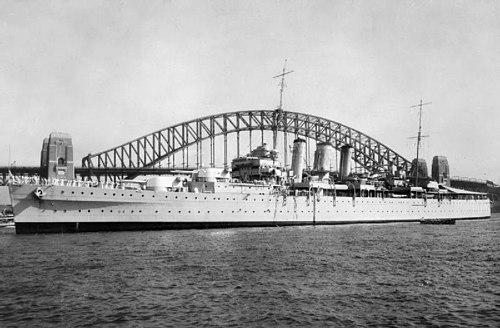
1 December 1941 · South Atlantic
Sinking of PythonBritish success; Python scuttled
After Atlantis was sunk, the supply ship Python took her crew aboard and went on to refuel the U-boats heading for the Cape. Codebreakers gave away the meeting, and on 1 December 1941 the cruiser Dorsetshire found her refuelling U-68 and UA. The U-boats dived; Dorsetshire fired a salvo to stop Python, and her crew scuttled her and took to the boats, while UA fired five torpedoes at the cruiser, all of which missed. Dorsetshire steamed off for fear of the U-boats, leaving more than 400 men in boats in mid-ocean. The U-boats took them in tow and aboard, and with the help of four Italian submarines brought every one of them back to France, 5,000 miles away.
1
vs
3 (1 lost)

7 December 1941 · Pearl Harbor, Oahu, Hawaii
Attack on Pearl HarborJapanese victory
Six Japanese carriers under Vice Admiral Chūichi Nagumo crossed the North Pacific in radio silence and, on a Sunday morning, launched 353 aircraft from 230 miles north of Oahu. An hour before they arrived the old destroyer Ward sank a midget submarine off the harbour mouth, but her report was not acted on. Two waves of torpedo bombers, dive bombers and high-level bombers caught the Pacific Fleet's battleships moored in pairs along Battleship Row. A bomb set off Arizona's forward magazines and killed 1,177 of her crew. Oklahoma capsized, West Virginia and California sank at their moorings, and Nevada, the only battleship to get under way, was beached to keep her from blocking the channel. In all 2,403 Americans were killed and 188 aircraft destroyed, for 29 Japanese aircraft and five midget submarines. But the American carriers were at sea, and the fuel tanks, repair yards and submarine base were barely touched. All but Arizona, Oklahoma and the old target ship Utah were repaired, and most of them fought again. The attack brought the United States into the war.
17 (6 lost)
vs
25 (5 lost)

10 December 1941 · Off Kuantan, Malaya
Sinking of Prince of Wales and RepulseJapanese victory
Prince of Wales and Repulse had been sent to Singapore to deter Japan, without the carrier meant to go with them. When Japan landed in Malaya, Admiral Tom Phillips took them north as Force Z to attack the invasion convoys, without air cover. He found nothing, turned back towards a false report of a landing at Kuantan, and on the morning of 10 December was found by 85 land-based bombers and torpedo bombers flying from Saigon. A torpedo early in the attack wrecked Prince of Wales's propeller shaft and flooded her machinery. Repulse dodged some nineteen torpedoes before more hit her from both sides, and she capsized. Prince of Wales sank an hour later. 840 men died, Phillips among them; the destroyers rescued over 2,000. Japan lost three aircraft. They were the first capital ships sunk by aircraft alone while under way at sea. Churchill wrote that in all the war he never received a more direct shock.
6 (2 lost)

11 December 1941 · Wake Island
Battle of Wake IslandAmerican victory
The first Japanese landing on Wake Island was beaten off. Rear Admiral Sadamichi Kajioka came in close at dawn with three light cruisers, six destroyers and two transports, sure that the bombing of the past three days had silenced the island. Major James Devereux's Marines held their fire until the ships were within about 4,500 yards, then opened up with their old 5-inch guns. They hit Yūbari several times and blew up the destroyer Hayate, the first Japanese surface warship lost in the war. Four surviving Marine Wildcat fighters then bombed and strafed the force and sank the destroyer Kisaragi. Kajioka withdrew, having lost about 340 men: the only time in the war that an amphibious landing was repulsed by coast defence guns. He came back with carrier support from Sōryū and Hiryū, and Wake fell on 23 December.
13 (2 lost)

13 December 1941 · Off Cape Bon, Tunisia
Battle of Cape BonAllied victory; both Italian cruisers sunk
With Rommel desperately short of fuel, two Italian light cruisers were sent to run petrol to Tripoli in drums stacked on their decks. Four destroyers under Commander Graham Stokes, three British and one Dutch, were on their way from Gibraltar to Alexandria, and were sent to intercept. The Italians had turned back after being sighted by an aircraft. In the dark, close inshore under Cape Bon, Stokes's destroyers came up behind them, hidden against the land, and fired torpedoes at under a mile. Alberico da Barbiano blazed up and Alberto di Giussano broke in two; both sank within minutes. About 900 Italian sailors were killed, among them Admiral Antonino Toscano. The torpedo boat Cigno escaped. The Allied destroyers were not touched.
4
vs
3 (2 lost)

14–15 December 1941 · Off Alexandria, Egypt
Sinking of GalateaGerman success; Galatea sunk
German U-boats had passed into the Mediterranean in the autumn of 1941 and within weeks sank Ark Royal and Barham. On the night of 14–15 December the cruiser Galatea was returning to Alexandria with destroyers after a fruitless sweep for Italian convoys when U-557, under Ottokar Paulssen, hit her with torpedoes just outside the harbour. She capsized and sank in about three minutes, and 469 men were killed. Two days later U-557 herself was rammed by mistake by the Italian torpedo boat Orione off Crete and lost with all hands.
1 (1 lost)
vs
1

19 December 1941 · Alexandria harbour, Egypt
Raid on AlexandriaItalian success; two British battleships disabled
The submarine Scirè, under Prince Junio Valerio Borghese, released three human torpedoes, electric torpedoes ridden by two divers, a mile off Alexandria. The crews slipped into the harbour behind British destroyers coming in through the opened boom. Luigi Durand de la Penne's machine broke down under Valiant and he dragged its warhead under her hull by hand; he and his partner were caught and held aboard Valiant, and he warned her captain only minutes before the charge went off. The second crew set their charge under Queen Elizabeth, and the third under the tanker Sagona, which also damaged the destroyer Jervis alongside her. Both battleships settled on the harbour bottom. They were kept upright to hide the damage from air reconnaissance, but Cunningham was left without a battle fleet in the eastern Mediterranean for months. All six Italians were captured. In 1945 Valiant's former captain pinned the Italian gold medal for valour on Durand de la Penne.
3
vs
4 (3 lost)
1942

24 January 1942 · Off Balikpapan, Borneo
Battle of BalikpapanAllied victory
The first surface action of the Pacific war, and the US Navy's first since 1898. Four old four-funnelled destroyers of the Asiatic Fleet under Commander Paul Talbot raced up the Makassar Strait to attack the Japanese invasion convoy anchored off Balikpapan. In the early hours they ran through the anchorage, silhouetted for the Japanese gunners by the oil fires the Dutch had lit ashore, firing torpedoes and guns. Many torpedoes missed, but they sank four transports and a patrol boat, while Rear Admiral Shōji Nishimura's escort went off chasing a submarine. All four destroyers got away. It hardly slowed the invasion.
4
vs
1 (5 lost)

11–13 February 1942 · English Channel, Strait of Dover and North Sea
Channel DashGerman success; the ships reached home, but two were mined
Hitler wanted Scharnhorst, Gneisenau and Prinz Eugen, bombed again and again at Brest, brought home to defend Norway. Vice-Admiral Otto Ciliax took them out after dark on 11 February and steamed straight up the English Channel in daylight, with destroyers, torpedo boats, E-boats and an umbrella of Luftwaffe fighters. Jammed radar, broken-down patrol aircraft and confusion meant the British did not spot them until late the next morning, off Le Touquet. The Dover guns fired and missed. Lieutenant-Commander Eugene Esmonde led six slow Swordfish of 825 Squadron against them with a handful of Spitfires; all six were shot down, and Esmonde was given a posthumous Victoria Cross. Six old destroyers from Harwich attacked off the Dutch coast, Worcester was badly hit, and RAF bombers flew hundreds of sorties without a hit. But Scharnhorst struck two air-laid mines and Gneisenau one. "Vice-Admiral Ciliax has succeeded where the Duke of Medina Sidonia failed," said The Times. Yet the ships were out of the Atlantic: Gneisenau was bombed in dock at Kiel two weeks later and never sailed again.
5
vs
23

19–20 February 1942 · Badung Strait, off Bali
Battle of Badung StraitJapanese victory
Japan landed troops on Bali to take its airfield, and Rear Admiral Karel Doorman attacked the shipping that night in three separate waves. Only four Japanese destroyers stood between him and the transports, but the Allied ships arrived piecemeal. In the first wave the Dutch destroyer Piet Hein was torpedoed and sunk. In the second, Tromp and the American destroyers came through and were badly mauled, with Tromp and Stewart heavily hit; the Japanese destroyers Ōshio and Michishio were also damaged. The landing went ahead.
18 (1 lost)
vs
4

23 February 1942 · Off the Trondheimsfjord, Norway
Trident torpedoes Prinz EugenBritish success; Prinz Eugen crippled
Ten days after the Channel Dash, Prinz Eugen and Admiral Scheer sailed north from Germany with five destroyers to join Tirpitz in Norway; heavy weather sent three of the destroyers back. On 23 February 1942, off the Trondheimsfjord, the submarine Trident, under Lieutenant-Commander Geoffrey Sladen, fired a salvo and hit Prinz Eugen right aft. The torpedo wrecked her stern and rudders and killed about 50 men. She reached Trondheim, where her stern was cut away and plated over and hand-worked rudders fitted, and she was not fully repaired until 1943.
1
vs
7

27 February 1942 · Java Sea, north of Surabaya
Battle of the Java SeaJapanese victory
The largest surface battle since Jutland, fought to stop the invasion of Java. Rear Admiral Karel Doorman led a scratch force of Dutch, American, British and Australian ships that had never trained together and had no common signal book. They met Rear Admiral Takeo Takagi's cruisers and destroyers covering the invasion convoy in the afternoon. The long-range gunnery duel went the Japanese way when an 8-inch shell from Haguro burst in Exeter's boiler room and she fell out of line, throwing the Allied column into confusion. A long-range Japanese torpedo broke Kortenaer in two, and Electra was sunk covering Exeter. Doorman fought on into the night trying to reach the transports. Jupiter blew up, probably on a Dutch mine, and at about 11 p.m. torpedoes from Nachi and Haguro sank Java and De Ruyter. Doorman went down with his flagship, having signalled the survivors to make for Batavia. About 2,300 Allied sailors died. Japan lost no ships, and landed on Java on 1 March.
14 (5 lost)
vs
18

28 February – 1 March 1942 · Sunda Strait, off Bantam Bay, Java
Battle of Sunda StraitJapanese victory
The night after the Java Sea, Houston and Perth, both damaged, tried to escape from Batavia through Sunda Strait to the Indian Ocean. Just before midnight they stumbled on the Japanese convoy landing the army in Bantam Bay, and attacked it. The escort of cruisers and destroyers closed in from every side and fired some 87 torpedoes. Perth, out of ammunition, was hit by four torpedoes and sank soon after midnight with Captain Hector Waller. Houston fought on alone until she too was torpedoed and sank; Captain Albert Rooks was killed. Of about 1,060 men aboard Houston, only 368 survived, and many of those died as prisoners on the Burma Railway. Torpedoes that missed the Allied cruisers ran into the Japanese anchorage, sinking a minesweeper and four transports, one of them carrying General Hitoshi Imamura, the commander of the invasion, who had to swim ashore. The Dutch destroyer Evertsen, following on, was caught and beached.
3 (3 lost)
vs
9 (5 lost)

1 March 1942 · Java Sea, south of Borneo
Second Battle of the Java SeaJapanese victory
Exeter, patched up at Surabaya but able to make only 23 knots, tried to slip out to Ceylon through Sunda Strait with the destroyers Encounter and Pope. On the morning of 1 March they were trapped between two groups of Japanese heavy cruisers, Nachi and Haguro, Myōkō and Ashigara, and their destroyers. Exeter fought for about two hours, losing all power, before she was torpedoed and sank; Encounter was sunk soon after. Pope escaped into a rain squall, only to be found by aircraft from the carrier Ryūjō and sunk. Most of the crews were picked up by the Japanese and spent the rest of the war as prisoners. The Allied fleet in the East Indies had ceased to exist.
3 (3 lost)
vs
9

9 March 1942 · Off the Lofoten Islands, Norway
Albacore attack on TirpitzGerman escape; no hits
On 6 March 1942 Tirpitz sailed from Trondheim with destroyers to attack the Arctic convoys PQ 12 and QP 8. In fog and snow she missed both, and her destroyers sank only a Soviet straggler. The Home Fleet came north to cut her off, and on the morning of 9 March a reconnaissance aircraft from the carrier Victorious found her running for the Vestfjord. Twelve Albacore torpedo bombers of 817 and 832 Squadrons attacked, but in a headwind they could only come at her from astern, and they split up. Tirpitz turned hard and dodged every torpedo, and shot down two of them. Hitler, shaken by how near she had come, forbade her to sail again if a carrier might be about.
1
vs
1

22 March 1942 · Gulf of Sirte, south-east of Malta
Second Battle of SirteBritish tactical victory; the convoy was saved, then lost off Malta
Malta was starving, and four supply ships sailed from Alexandria escorted by Rear-Admiral Philip Vian's light cruisers and destroyers. Admiral Iachino came out with the battleship Littorio, three cruisers and ten destroyers to stop them. In a rising gale Vian sent the convoy south-west and fought a two-and-a-half-hour action with smoke and torpedoes, his ships dashing out of the smoke to fire and back into it, while the Italians, with no radar, would not go into it after them. Littorio's 15-inch shells hit Havock and Kingston, and Cleopatra's bridge was hit by Bande Nere; no British ship was sunk. Iachino turned away at dusk without reaching the convoy, and on the way home the destroyers Lanciere and Scirocco foundered in the storm. But the action had delayed the convoy until daylight, and German bombers caught it short of Malta: Clan Campbell and Breconshire were sunk, and Pampas and Talabot bombed in harbour. Of 26,000 tons of supplies, about 5,000 were landed.
15 (4 lost)
vs
14 (2 lost)

29 March 1942 · Barents Sea, north of the Kola Peninsula
Convoy PQ 13 destroyer actionBritish success; Z26 sunk, Trinidad damaged by her own torpedo
Convoy PQ 13 had been scattered by a gale on its way to Murmansk. On 28 March Z24, Z25 and Z26 sailed from Kirkenes and sank one straggler. The next morning, in a snowstorm, they ran into the cruiser Trinidad and the destroyer Fury. Trinidad's guns crippled Z26. Trinidad then fired a torpedo at her, but in the freezing water its steering failed and it circled back and hit Trinidad herself, killing 32 men. The destroyer Eclipse caught Z26 in the snow and finished her off, but Z24 and Z25 came up, hit Eclipse twice and picked up 88 of Z26's crew. Trinidad reached Murmansk; on her way home in May she was bombed and had to be scuttled.
3
vs
3 (1 lost)

5 April 1942 · Colombo and the sea south-west of Ceylon
Easter Sunday raidJapanese victory
Nagumo's carriers swept into the Indian Ocean to strike the British Eastern Fleet. Admiral James Somerville, warned by codebreakers, had pulled his fleet back to a secret base at Addu Atoll in the Maldives. On Easter Sunday 350 Japanese aircraft attacked Colombo, sinking the destroyer Tenedos and an armed merchant cruiser in harbour. That afternoon scout planes found the heavy cruisers Cornwall and Dorsetshire hurrying south to rejoin Somerville, and fifty-three dive bombers sank both of them in about twenty minutes, with very accurate bombing. 424 men were killed; over 1,100 survivors spent a day and a half in the water before they were rescued.
12
vs
3 (3 lost)

9 April 1942 · Off Batticaloa, eastern Ceylon
Raid on Trincomalee and the sinking of HermesJapanese victory
Four days after Colombo, Nagumo's aircraft struck the naval base at Trincomalee. The ships there had been sent out to sea, but Japanese scouts found the old carrier Hermes, with no aircraft aboard, and the Australian destroyer Vampire heading back south along the coast. About seventy dive bombers sank Hermes in some twenty minutes and then Vampire, the corvette Hollyhock and other ships nearby. 307 men died on Hermes; a hospital ship nearby picked up most of the survivors. British Blenheim bombers that attacked the Japanese carriers did no damage. Nagumo then went home to prepare for Midway, and Japanese carriers never came back to the Indian Ocean.
5
vs
3 (3 lost)

30 April – 2 May 1942 · Barents Sea, north of Murmansk
Sinking of EdinburghBoth sides lost a ship; Edinburgh and Hermann Schoemann sunk
The cruiser Edinburgh left Murmansk with convoy QP 11 carrying more than four tons of Soviet gold, part-payment for Allied supplies. On 30 April U-456 hit her with two torpedoes that blew off her stern and steering, and she turned back for Murmansk at a crawl, steered by a minesweeper towing her stern. On 1 May the destroyers Hermann Schoemann, Z24 and Z25 attacked the convoy; its four escorting destroyers beat them off five times, though Amazon was badly hit. The Germans went after Edinburgh instead. They found her the next morning with two destroyers and four minesweepers. Steaming in circles, Edinburgh opened fire and wrecked Hermann Schoemann's engine rooms with her second salvo. Foresight and Forester were both badly hit, and a German torpedo struck Edinburgh on the side away from the first hits, almost cutting her in two. Her crew were taken off by the minesweepers, and Foresight sank her with her last torpedo. Hermann Schoemann was scuttled; Z24 and Z25 took off most of her crew. In 1981 divers brought up almost all the gold.
11 (1 lost)
vs
4 (1 lost)

4–8 May 1942 · Coral Sea, between Australia and the Solomon Islands
Battle of the Coral SeaJapanese tactical victory; Allied strategic victory
The first battle between aircraft carriers, and the first naval battle in which the ships never saw each other. Japan sent an invasion force to take Port Moresby in New Guinea, covered by the light carrier Shōhō and by Shōkaku and Zuikaku. Warned by codebreakers, Rear Admiral Frank Jack Fletcher brought Lexington and Yorktown into the Coral Sea. On 4 May Yorktown's aircraft raided the new Japanese base at Tulagi. On 7 May each side struck the wrong target: Japanese aircraft sank the oiler Neosho and the destroyer Sims, taking them for a carrier group, while American aircraft found and sank Shōhō. Rear Admiral John Crace's cruisers, sent ahead to block the invasion route, beat off a heavy air attack untouched. On 8 May the two carrier forces found each other at last. Three bombs wrecked Shōkaku's flight deck; two torpedoes and two bombs hit Lexington and one bomb hit Yorktown. Hours later fumes from Lexington's cracked petrol tanks blew up, and she was abandoned and scuttled. Japan had sunk the bigger ship, but the Port Moresby invasion was turned back, and Shōkaku and Zuikaku, one damaged and the other short of aircrew, missed the Battle of Midway a month later.
12 (3 lost)
vs
10 (5 lost)
12–13 May 1942 · English Channel, off Boulogne
Stier's passage of the ChannelGerman success; Stier got through, but two torpedo boats were sunk
After the Channel Dash the Germans sent their raiders out through the Channel rather than round Scotland. On the night of 12–13 May 1942 the raider Stier came down from the North Sea with a strong escort of torpedo boats and minesweepers. Dover's guns fired on the convoy, and British motor torpedo boats attacked it off Boulogne. The torpedo boats Iltis and Seeadler were both torpedoed and sunk; Seeadler broke in two and 85 of her men were lost. The British lost MTB 220. Stier reached the Gironde and sailed for the Atlantic, where she met Stephen Hopkins four months later.
0 (1 lost)
vs
2 (2 lost)

4–7 June 1942 · North-west of Midway Atoll
Battle of MidwayDecisive American victory
Admiral Isoroku Yamamoto planned to take Midway Atoll and draw out the American carriers to be destroyed. But US Navy codebreakers at Pearl Harbor had read enough of the plan to know where and when, and Admiral Chester Nimitz put Enterprise, Hornet and the hastily repaired Yorktown north-east of Midway to wait. On the morning of 4 June Nagumo's four carriers struck Midway, and beat off attacks by land-based aircraft. While he was rearming his planes, wave after wave of American torpedo bombers attacked; almost all were shot down, Torpedo Squadron 8 from Hornet to the last aircraft, and none hit. But they had pulled the Japanese fighters down low, and at about 10:25 dive bombers from Enterprise and Yorktown arrived together overhead. In about five minutes Akagi, Kaga and Sōryū were set ablaze among their own fuelled and armed aircraft. Hiryū struck back twice and crippled Yorktown, before Enterprise's dive bombers found her that afternoon. All four Japanese carriers sank or were scuttled. Yamamoto's battleships, far behind, could not bring the Americans to action, and he called off the invasion. On 6 June dive bombers sank the cruiser Mikuma; the next day I-168's torpedoes finished Yorktown. Japan lost four carriers, over 3,000 men and 248 aircraft; America lost Yorktown, Hammann, 307 men and about 150 aircraft. The Japanese navy never again had the upper hand in the Pacific.
12 (2 lost)
vs
26 (5 lost)

8–9 August 1942 · Off Savo Island, Solomon Islands
Battle of Savo IslandJapanese victory
Two days after American Marines landed on Guadalcanal and Tulagi, Admiral Gunichi Mikawa brought seven cruisers and a destroyer down the Slot from Rabaul. Allied aircraft sighted him but the reports were slow and wrong, and the cruisers guarding the transports were spread round Savo Island in three groups, their commander Rear Admiral Victor Crutchley away at a conference in his flagship Australia. The Japanese slipped past the two radar picket destroyers in the dark. Their seaplanes dropped flares, and at about 1:40 a.m. they wrecked the southern group with gunfire and long-range torpedoes: Canberra was crippled before she fired a shot and Chicago lost her bow. Mikawa then swung round Savo and caught the northern group, whose captains thought the firing to the south was at aircraft; Vincennes, Quincy and Astoria were all sunk. In about 40 minutes more than 1,000 Allied sailors were killed, for 58 Japanese, one of the worst defeats in the US Navy's history. But Mikawa, fearing American carriers at dawn, turned back without attacking the transports, and the landings went on. The next day the transports withdrew, leaving the Marines short of supplies, and the waters off Guadalcanal soon took the name Ironbottom Sound.
12 (5 lost)
vs
8

10–15 August 1942 · Western Mediterranean to Malta
Operation PedestalStrategic British success; Malta relieved at heavy cost
Malta had weeks of fuel and food left when fourteen fast merchant ships sailed from Gibraltar with the strongest escort of any Malta convoy: two battleships, three carriers, seven cruisers and more than thirty destroyers. On 11 August U-73 sank Eagle with four torpedoes. Next day waves of Italian and German aircraft hit Indomitable and the destroyer Foresight. As the heavy ships turned back at the Skerki Channel, the Italian submarine Axum hit Nigeria, Cairo and the tanker Ohio with one salvo, and the convoy fell into confusion. That night Italian and German motor torpedo boats off Cape Bon sank Manchester and four merchant ships, and in the morning bombers sank more. An Italian cruiser force sent to finish the convoy was recalled for lack of air cover, and HMS Unbroken torpedoed two of its cruisers on the way home. Five merchant ships reached Malta. The last was Ohio, her back broken, lashed between two destroyers and towed in on 15 August, the Feast of Santa Marija, to crowds on the walls of Grand Harbour. Her fuel kept Malta's aircraft flying through the autumn, when they and its submarines cut Rommel's supplies before El Alamein.
32 (13 lost)
vs
9 (2 lost)

24–25 August 1942 · North of the Solomon Islands
Battle of the Eastern SolomonsAmerican victory
The third carrier battle of the war. Japan sent its carriers south to cover a convoy taking reinforcements to Guadalcanal, sending the light carrier Ryūjō ahead to strike Henderson Field and draw American attention. Admiral Frank Jack Fletcher's aircraft from Saratoga duly sank her. Meanwhile scouts found Shōkaku and Zuikaku, but too late for a full strike, and their dive bombers hit Enterprise with three bombs, killing 74 men; her crew had her landing aircraft again within an hour. The next morning Marine and Navy dive bombers from Henderson Field hit the convoy, sinking the transport Kinryū Maru and damaging Admiral Raizō Tanaka's flagship Jintsū, and B-17s from Espiritu Santo sank the destroyer Mutsuki. The convoy turned back. Japan lost about 75 aircraft and their experienced crews, the Americans about 25.
5
vs
15 (3 lost)

25 August 1942 · Kara Sea, near Belukha Island
Sinking of SibiryakovGerman success; Sibiryakov sunk, but the raid was given away
In Operation Wunderland Admiral Scheer was sent round the north of Novaya Zemlya into the Kara Sea to attack Soviet convoys on the Northern Sea Route, where no German warship had been. Ice and fog kept her from the convoys. On 25 August 1942 she met the old icebreaking steamer A. Sibiryakov, carrying supplies and people to the polar stations. Captain Anatoli Kacharava refused to stop, radioed a warning to the mainland, and opened fire with his small guns. Scheer sank her in minutes, and an engineer opened the sea cocks so the Germans could not take her. Scheer took a few prisoners; most of the rest were killed. The warning cost the Germans surprise.
1
vs
1 (1 lost)
27 August 1942 · Dikson, at the mouth of the Yenisei
Bombardment of DiksonSoviet success; the landing was called off
Warned by Sibiryakov, the Soviet port of Dikson got ready. Admiral Scheer arrived in the early hours of 27 August 1942 meaning to land a party, destroy the port and seize papers on the ice. She found the armed steamers Semyon Dezhnev and Revolyutsioner in the harbour and set both on fire, and shelled the radio station and buildings. But two 152-mm guns, which had been waiting on the quay to be shipped elsewhere, fired back, and after about forty minutes Scheer drew off into the fog. Both Soviet ships were working again within days. Scheer returned to Narvik on 30 August, and the Germans never sent a surface ship to the Kara Sea again.
1
vs
2

12–16 September 1942 · South Atlantic, north-east of Ascension Island
Laconia incidentGerman success, then disaster for the survivors; led to the Laconia Order
On the night of 12 September 1942 Werner Hartenstein in U-156 torpedoed the troopship Laconia off West Africa. Then he heard Italian voices in the water: she was carrying some 1,800 Italian prisoners of war as well as British soldiers, women and children. Hartenstein began picking up survivors and broadcast in plain English that he would not attack any ship coming to help if he was not attacked himself. U-506, U-507 and the Italian submarine Cappellini joined him, and Vichy French warships sailed from Dakar to take the survivors off. On 16 September, with four lifeboats in tow and a Red Cross flag on his gun, Hartenstein was attacked by an American B-24 from Ascension. He had to cast off the boats and dive. About 1,600 people died in all. Dönitz then issued the Laconia Order, forbidding U-boats to rescue survivors, which was put to him at Nuremberg.
1 (1 lost)
vs
4
vs
3

15 September 1942 · South-east of San Cristóbal, Solomon Islands
Sinking of WaspJapanese victory
Wasp and Hornet were covering a convoy taking the 7th Marines to Guadalcanal when the submarine I-19 fired six torpedoes at Wasp. Three hit her by the fuel tanks and magazines, and she was soon burning from end to end; her crew abandoned her and the destroyer Lansdowne sank her with torpedoes. 193 men died. The other torpedoes ran on some miles to Hornet's group, hitting the battleship North Carolina and the destroyer O'Brien, which later broke up on the way home. With Saratoga torpedoed in August and Enterprise under repair, Hornet was for a time the only American carrier left in the South Pacific. The convoy got through.
5 (1 lost)
vs
1
27 September 1942 · South Atlantic, midway between Brazil and Africa
Stephen Hopkins and StierBoth ships sunk
On a misty morning in the South Atlantic the raider Stier and her supply ship Tannenfels came on the Liberty ship Stephen Hopkins, on her maiden voyage in ballast from Cape Town. Ordered to stop, Captain Paul Buck turned to fight with her single old 4-inch gun and a few machine guns. Her naval armed guard under Ensign Kenneth Willett, and then, when they were all down, a cadet, Edwin O'Hara, who fired the last five shells on his own, hit Stier about fifteen times, wrecking her steering and engine room. Stier's guns and Tannenfels's set the Liberty ship ablaze, and she sank; then Stier, on fire and out of control, had to be scuttled, and Tannenfels took off her crew. Of the 57 aboard Stephen Hopkins, 42 were killed; the rest reached Brazil a month later in an open lifeboat. She was the only American merchant ship to sink a German surface warship.
1 (1 lost)
vs
2 (1 lost)

11–12 October 1942 · Between Savo Island and Cape Esperance, Guadalcanal
Battle of Cape EsperanceAmerican victory
Rear Admiral Norman Scott was waiting with four cruisers and five destroyers when Rear Admiral Aritomo Gotō came down the Slot to shell Henderson Field, while a separate Japanese group brought heavy guns and troops. Helena's radar found the Japanese, and by luck Scott crossed their T. Gotō, sure that the ships firing at him were Japanese, flashed recognition signals; Aoba was wrecked and he was mortally wounded. Furutaka and the destroyer Fubuki were sunk. In the confusion the Americans also fired on their own destroyers, sinking Duncan, and Boise was saved from blowing up only by seawater flooding her burning magazine. The next day aircraft sank two destroyers sent back for survivors. It was the first American night victory over the Japanese navy, but the reinforcement group landed its guns and men unnoticed.
9 (1 lost)
vs
15 (4 lost)
13–14 October 1942 · Off Lunga Point, Guadalcanal
Bombardment of Henderson FieldJapanese success
Two nights after Cape Esperance the fast battleships Kongō and Haruna, under Vice Admiral Takeo Kurita, steamed up and down off Lunga Point for an hour and a half and fired 973 fourteen-inch shells into Henderson Field, many of them new incendiary shells meant for aircraft. The Marines called it simply "the Bombardment". It killed 41 men, wrecked about 48 of the 90 aircraft on the field and burned most of the aviation fuel. Four PT boats from Tulagi attacked but hit nothing. The field was flying again within days, and a Japanese convoy that landed troops the next night lost three transports to the planes that were left.
4
vs
3

14 October 1942 · English Channel, off Cap de la Hague
Sinking of KometBritish victory; Komet sunk with all hands
The raider Komet, back from a cruise of more than 500 days through the Pacific, set out on a second cruise in October 1942. Rather than go round the north of Scotland, she was sent down the Channel from Le Havre by night, with torpedo boats and minesweepers as escort. The British knew she was coming, and sent Hunt-class destroyers and motor torpedo boats to wait for her. Off Cap de la Hague, just after midnight on 14 October, the destroyers lit up the convoy with star shell and opened fire; in the confusion MTB 236, under Sub-Lieutenant Robert Drayson, crept in and fired two torpedoes at Komet. She blew up and sank with all hands. The explosion lifted the stern of the MTB and knocked out two of her engines, but she got home.
10
vs
1 (1 lost)

25–27 October 1942 · North of the Santa Cruz Islands
Battle of the Santa Cruz IslandsJapanese tactical victory; American strategic success
The Japanese army planned to take Henderson Field in late October, and the Combined Fleet came south to finish the American carriers. Rear Admiral Thomas Kinkaid had Enterprise, newly repaired, and Hornet. Both sides struck on the morning of 26 October. Enterprise's scouts put two bombs into Zuihō, and Hornet's dive bombers wrecked Shōkaku's flight deck, but Japanese aircraft hit Hornet with bombs, torpedoes and two crashing planes, and then hit Enterprise twice. South Dakota's new anti-aircraft guns shot down many attackers; a burning plane crashed onto the destroyer Smith. Hornet was hit again that afternoon and abandoned. American destroyers could not sink her and left her burning; Japanese destroyers finished her with torpedoes that night. America had lost a carrier and was left with only one damaged one in the Pacific. But Japan lost 99 aircraft and 148 of its best aircrew, more than at Midway, and its carriers had to go home to train new ones. The army attack on Henderson Field had already failed.
11 (2 lost)
vs
12
30 October 1942 · Eastern Mediterranean, off Port Said
Sinking of U-559British success; U-559 sunk and her codebooks taken
A Wellesley aircraft sighted U-559 north of Port Said on 30 October 1942, and five destroyers, Petard, Pakenham, Hero, Dulverton and Hurworth, hunted her for sixteen hours with depth charges. Late that night she was forced to the surface and her crew abandoned her. Lieutenant Tony Fasson and Able Seaman Colin Grazier of Petard swam across and climbed down into the sinking boat, followed by a sixteen-year-old canteen assistant, Tommy Brown. They passed up her codebooks and Enigma papers, but the U-boat sank suddenly with Fasson and Grazier still inside. The weather tables they saved let Bletchley Park break the four-rotor U-boat cipher, Shark, which had been closed to it for ten months. Fasson and Grazier were given the George Cross.
5
vs
1 (1 lost)

13 November 1942 · Ironbottom Sound, off Guadalcanal
Naval Battle of Guadalcanal: first nightTactically indecisive; American strategic victory
Vice Admiral Hiroaki Abe brought the battleships Hiei and Kirishima to shell Henderson Field ahead of a big convoy. Rear Admiral Daniel Callaghan met him in the dark at about 1:45 a.m. with five cruisers and eight destroyers in a single long column. Callaghan's flagship had no modern radar, his orders were confused, and the two forces ran into each other at point-blank range. In a melee lasting about forty minutes ships fired on anything near them, friend or foe. Callaghan and his captain were killed on San Francisco's bridge, and Rear Admiral Norman Scott on Atlanta's. Four American destroyers were sunk, Atlanta was scuttled, and later that morning I-26 sank the damaged Juneau, killing the five Sullivan brothers among almost all her crew. The Japanese lost two destroyers, and Hiei, hit by some 85 shells and with her steering wrecked, was finished by aircraft and scuttled that evening: the first Japanese battleship lost in the war. Abe called off the bombardment. Henderson Field kept flying, and its planes went after the convoy the next day.
13 (6 lost)
vs
15 (3 lost)
14–15 November 1942 · West of Savo Island
Naval Battle of Guadalcanal: second nightAmerican victory
On 14 November aircraft from Henderson Field and Enterprise sank the heavy cruiser Kinugasa and caught Admiral Tanaka's eleven transports coming down the Slot, sinking seven. Tanaka pressed on with the other four. That night Vice Admiral Nobutake Kondō came to shell the airfield with Kirishima and his cruisers, and found Rear Admiral Willis Lee waiting with Washington and South Dakota, the first time the Americans had risked battleships in these waters. Japanese torpedoes and gunfire quickly sank or crippled all four of Lee's destroyers. Then an electrical failure left South Dakota unable to fire or see, and lit by searchlights she took 26 hits. But the Japanese never noticed Washington. Closing in by radar, she hit Kirishima with at least nine 16-inch shells and many 5-inch in about seven minutes, and the Japanese battleship was scuttled before dawn. Kondō withdrew. Tanaka's four transports ran themselves ashore at Tassafaronga, where aircraft, artillery and a destroyer destroyed them and most of their supplies. Over the three days about 1,700 Americans and 1,900 Japanese sailors died. Japan never again tried to retake Guadalcanal in force.
7 (3 lost)
vs
36 (14 lost)

30 November 1942 · Off Tassafaronga Point, Guadalcanal
Battle of TassafarongaJapanese victory
Rear Admiral Raizō Tanaka brought eight destroyers down the Slot loaded with drums of supplies to be pushed over the side for the troops ashore. Rear Admiral Carleton Wright was waiting with five cruisers and six destroyers, and his radar saw the Japanese first. But he hesitated for four minutes before letting his destroyers fire torpedoes, at long range, and all of them missed. When the cruisers opened fire they concentrated on the nearest destroyer, Takanami, and sank her. The rest of Tanaka's ships turned and fired some 44 of their long-range Type 93 "Long Lance" torpedoes. Minneapolis and New Orleans had their bows blown off, Pensacola was set on fire, and Northampton was hit twice and sank. 395 Americans died. The Japanese, however, had dropped none of their supplies, and the troops on Guadalcanal went on starving.
11 (1 lost)
vs
8 (1 lost)

31 December 1942 · Barents Sea, north of North Cape
Battle of the Barents SeaBritish victory; the convoy got through and Hitler turned against his big ships
When U-354 reported convoy JW 51B, fourteen merchant ships bound for Murmansk, Vice-Admiral Oskar Kummetz sailed from Altafjord with Admiral Hipper, Lützow and six destroyers, splitting them to catch the convoy between two forces in the twilight of the polar winter. His orders told him not to risk his ships. On the morning of 31 December the convoy's five destroyers, under Captain Robert Sherbrooke in Onslow, turned on Hipper, feinting torpedo attacks and laying smoke, and kept her away from the merchant ships for more than two hours. Hipper hit Onslow, wounding Sherbrooke, who kept command with one eye destroyed and was given the Victoria Cross; she sank the destroyer Achates and, with her destroyers, the minesweeper Bramble. Then the cruisers Sheffield and Jamaica, under Rear-Admiral Robert Burnett, came out of the dark and hit Hipper three times. Friedrich Eckoldt, taking Sheffield for Hipper, closed and was blown apart. Lützow, coming up from the south, fired at the convoy in poor light and hit nothing. Kummetz broke off. No merchant ship was lost. Hitler, in a rage, ordered the big ships paid off and scrapped; Grand Admiral Raeder resigned, and Karl Dönitz took his place.
26 (2 lost)
vs
9 (1 lost)
1943
29 January 1943 · Off Kamimbo Bay, Guadalcanal
Kiwi and Moa against I-1New Zealand victory
Two small New Zealand minesweeping trawlers on patrol off the north-west of Guadalcanal picked up the submarine I-1, more than three times their size, coming in with supplies. She surfaced and fought it out with her deck gun while Kiwi, under Lieutenant Commander Gordon Bridson, rammed her three times. The submarine ran aground on a reef and was abandoned. Her crew tried to destroy her secret papers, but the Allies recovered codebooks and other documents from the wreck, and Japan had to change its codes.
1 (1 lost)
vs
2

29–30 January 1943 · Between Rennell Island and San Cristóbal
Battle of Rennell IslandJapanese victory
The last big naval action of the campaign. Rear Admiral Robert Giffen was taking a convoy towards Guadalcanal with six cruisers and two escort carriers, but he left the slow carriers behind to keep his appointment. At dusk on 29 January Japanese land-based torpedo bombers attacked from the darkening sky, and two torpedoes hit Chicago. Louisville took her in tow, but the next afternoon more bombers put four more torpedoes into her and she sank, with 62 of her crew. Aircraft from Enterprise shot down several of the attackers. The Japanese believed they had sunk a battleship and three cruisers; in fact the attacks drew attention away from their own secret operation, the evacuation of Guadalcanal, which began two days later.
10 (1 lost)

21 April 1943 · Tyrrhenian Sea, off Capri
Sinking of SplendidGerman success; Splendid scuttled
The submarine Splendid had sunk several Axis ships off Italy when, on the morning of 21 April 1943, her periscope was sighted off Capri by Hermes, the former Greek destroyer Vasilefs Georgios, now in German service. Hermes found her by sonar and made three attacks with 41 depth charges. The last eleven sprang leaks in Splendid's hull, and Lieutenant Ian McGeoch had to surface. Hermes's guns killed 18 of her crew, and McGeoch scuttled her; the rest were taken prisoner. A week later Hermes herself was crippled by Allied bombers off Tunisia.
1 (1 lost)
vs
1

8 September 1943 · Spitsbergen, Svalbard
Raid on SpitsbergenGerman success; the settlements destroyed, but reoccupied within weeks
Small Norwegian garrisons held the coal mines and weather stations on Spitsbergen. In Operation Zitronella, Tirpitz, Scharnhorst and nine destroyers carried a battalion of infantry north from Altafjord and arrived off Isfjorden on 8 September 1943. Tirpitz, flying a British ensign as she came in, fired her main guns at the Norwegian battery, the only time she ever fired them at a target on land or sea. The destroyers landed the troops at Barentsburg and Longyearbyen, and the garrison's few guns hit several of them before they were silenced. The Germans burned the coal heaps, power plants and stores, took dozens of prisoners and left the same day. It was the only time Tirpitz fired in anger. Norwegian troops were back within weeks, and two weeks later the X-craft attacked Tirpitz in Kåfjord.

9 September 1943 · Gulf of Asinara, off north-west Sardinia
Sinking of RomaGerman success; Roma sunk on the way to surrender
On the day Italy's armistice was announced, Admiral Carlo Bergamini sailed from La Spezia with Roma, Italia (the former Littorio), Vittorio Veneto, six cruisers and destroyers to hand the fleet over to the Allies. In the afternoon German Dornier bombers attacked with the Fritz X, a radio-guided armour-piercing glide bomb used here against warships for the first time. One hit Italia; two hit Roma, the second setting off her forward magazines. She broke in two and sank in minutes. 1,393 men were killed, among them Bergamini. The rest of the fleet sailed on, and on 11 September Cunningham signalled the Admiralty that the Italian battle fleet lay at anchor under the guns of the fortress of Malta. A week later a Fritz X put Warspite out of action off Salerno.
9 (1 lost)

20–22 September 1943 · Kåfjord, Altafjord, northern Norway
Operation SourceBritish success; Tirpitz put out of action for six months
Six X-craft, four-man midget submarines each carrying two two-ton charges, were towed across the North Sea by ordinary submarines to attack Tirpitz, Scharnhorst and Lützow in their Norwegian anchorages. Two were lost on the way, and X10, sent for Scharnhorst, found her gone and had to turn back. Early on 22 September X6, under Lieutenant Donald Cameron, and X7, under Lieutenant Godfrey Place, got through the anti-submarine and torpedo nets around Tirpitz in Kåfjord. X6 was spotted and fired on; Cameron dropped his charges under the battleship's keel and scuttled his boat, and his crew were taken aboard Tirpitz. Place laid his charges and was caught in the nets. When the charges went off, Tirpitz was heaved out of the water: turbines, a turret and her rudder were damaged, and she was out of action until April 1944. X5 was sunk with all hands nearby. Cameron and Place, both captured, were given the Victoria Cross.
12 (6 lost)
vs
1

17 October 1943 · Pacific, south of Hachijō-jima, Japan
Sinking of MichelAmerican success; the last German raider sunk
Michel was the last of Germany's disguised raiders still at sea, working from Japan in 1943 under Günther Gumprich. Setting out on a new cruise, she was picked up at night south of Tokyo Bay on 17 October 1943 by the submarine Tarpon, on patrol. Tarpon hit her with two torpedoes and, when she did not sink, two more. Michel went down with 263 of her crew; the survivors reached Japan in boats. Tarpon's crew did not learn what they had sunk until after the war.
1
vs
1 (1 lost)

23 October 1943 · English Channel, off the Sept-Îles, Brittany
Battle of Sept-ÎlesGerman victory; Charybdis and Limbourne sunk without loss
The blockade runner Münsterland was trying to get up the Channel from Brest, and the British sent the cruiser Charybdis with two fleet destroyers and four Hunts to catch her. They had never worked together and had no common radio net. Five torpedo boats of the German 4th Flotilla, covering Münsterland, picked them up on their hydrophones and radar in the dark early on 23 October 1943, and fired torpedoes before the British saw them. Two hit Charybdis, which rolled over and sank, and another blew the bow off Limbourne, which was later scuttled. 462 men were lost from Charybdis and 46 from Limbourne. The German boats were not touched. Many of the dead washed ashore in the Channel Islands, where thousands of islanders came to their funerals, defying the occupiers.
7 (2 lost)
vs
5

26 December 1943 · Barents Sea, off the North Cape
Battle of the North CapeBritish victory; Scharnhorst sunk
On Christmas Day 1943 Scharnhorst, the last German battleship fit for sea, sailed from Altafjord with five destroyers under Rear-Admiral Erich Bey to attack convoy JW 55B. British codebreakers read the signals, and Admiral Bruce Fraser was waiting to the south-west with the battleship Duke of York. In darkness and a gale on the morning of 26 December Bey sent his destroyers off to search; they never found the convoy, and took no part in what followed. Vice-Admiral Robert Burnett's cruisers Belfast, Norfolk and Sheffield found Scharnhorst by radar, hit her and twice drove her off the convoy. That afternoon, steering for home, she ran into Duke of York. Blinded by star shell and outranged in the dark by radar-directed 14-inch guns, she was hit again and again; a shell in her boiler room slowed her, and Fraser's destroyers closed in from both sides with torpedoes. Belfast and Jamaica finished her. She sank at 19:45. Of 1,968 men aboard, 36 were saved; Bey and her captain, Fritz Hintze, were not among them. It was the last battle between big-gun ships in European waters.
32
vs
6 (1 lost)

27–28 December 1943 · Bay of Biscay, north-west of Cape Ortegal
Battle of the Bay of BiscayBritish victory; Z27, T25 and T26 sunk
Germany needed rubber and tin from the Far East, and in December 1943 the destroyers and torpedo boats in western France sailed to bring in the blockade runner Alsterufer. She had already been sunk by a Liberator, but the Germans did not know it. On 28 December their force, five destroyers under Hans Erdmenger and six torpedo boats, ran into the cruisers Glasgow and Enterprise, sent out to intercept. The Germans had more guns, but in a heavy sea the small ships could barely use them, while the cruisers were steady. Erdmenger split his force into two groups. The cruisers chased the northern one and sank Z27, with Erdmenger, and the torpedo boats T25 and T26. Glasgow was hit once and two men were killed. The Irish steamer Kerlogue picked up 168 survivors and took them to Ireland, where they were interned.
2
vs
12 (4 lost)
1944

3 April 1944 · Kåfjord, Altafjord, northern Norway
Operation TungstenBritish success; Tirpitz badly damaged again
Tirpitz was just ready for sea trials after the X-craft damage when the Home Fleet's carriers struck. Early on 3 April 1944 forty Barracuda dive bombers from Victorious and Furious, with escorting fighters from four escort carriers, came in over the mountains in two waves before her smoke screen could hide her. They hit her fifteen times. The bombs were too light to pierce her main armour deck, but they wrecked her upperworks and killed more than 120 men. Only two aircraft were lost. Tirpitz was out of action again for three months.
6
vs
1
26 April 1944 · English Channel, off the north coast of Brittany
Action off the Île de BatzAllied success; T29 sunk
Before D-Day the Allies set out to clear the German torpedo boats from the western Channel. On the night of 25–26 April 1944 T24, T27 and T29 had been laying mines off the Sept-Îles when the cruiser Black Prince and the destroyers Ashanti, Athabaskan, Haida and Huron caught them by radar. The torpedo boats ran west. T27 and T24 were hit but got away, while T29 lost her steering, and the destroyers circled her, firing, for over an hour before she sank. Ashanti and Huron collided in the dark.
5
vs
3 (1 lost)

28 April 1944 · Lyme Bay, off Devon and Dorset
Exercise TigerGerman success; two landing ships sunk and about 750 Americans killed
American troops rehearsed the Utah Beach landing at Slapton Sands in Devon in late April 1944. In the early hours of 28 April a convoy of eight tank landing ships carrying engineers and vehicles was crossing Lyme Bay with only the corvette Azalea as escort; the destroyer Scimitar, which should have been there too, had been damaged in a collision. Nine E-boats from Cherbourg found the LSTs strung out in a line. LST-507 and LST-531 were torpedoed and sunk, and LST-289 was set on fire. About 750 American soldiers and sailors were killed, many drowned for want of knowing how to wear their life jackets. The E-boats escaped untouched. The disaster was kept secret before D-Day, and ten officers who knew the invasion plans were missing until all their bodies were found.
9 (2 lost)
vs
9

29 April 1944 · English Channel, off the Île Vierge, Brittany
Sinking of AthabaskanBoth sides lost a ship; Athabaskan sunk and T27 driven ashore
Three nights later T24 and T27 were moving from Saint-Malo to Brest when Athabaskan and Haida intercepted them off the Île Vierge. The Canadians fired star shell; the Germans laid smoke, turned away and fired torpedoes. One hit Athabaskan, which blew up and sank. Haida went after T27, hit her repeatedly and drove her ashore in flames. Then Haida's captain, Harry DeWolf, came back and stopped among the survivors in the water, with dawn coming and the enemy coast a few miles away, and picked up as many as he could. 128 of Athabaskan's crew were killed, and most of the rest were taken prisoner by the Germans. T27 was wrecked on the rocks and destroyed by British motor torpedo boats and aircraft a few days later.
2 (1 lost)
vs
2 (1 lost)

4 June 1944 · Atlantic, off Cape Blanco, West Africa
Capture of U-505American success; U-505 captured
Captain Daniel Gallery's hunter-killer group, the escort carrier Guadalcanal and five destroyer escorts, had been searching for U-boats off West Africa for weeks, helped by codebreaking, and Gallery had made a plan to capture one. On the morning of 4 June 1944 Chatelain picked up U-505 on sonar, and her depth charges, guided by fighters from the carrier, holed her and forced her to the surface. Her crew abandoned ship under fire, and one man was killed. A boarding party from Pillsbury under Lieutenant (jg) Albert David climbed down the conning tower, shut a sea cock the Germans had opened, pulled away scuttling charges, and took her Enigma machine and code books. Guadalcanal took her in tow. Her 58 surviving crew were held apart from other prisoners so that Germany would believe she had sunk. She was the first enemy warship captured at sea by the US Navy since 1815, and is now a museum ship in Chicago.
6
vs
1 (1 lost)

9 June 1944 · English Channel, off the Île de Batz, Brittany
Battle of UshantAllied victory; ZH1 sunk and Z32 driven ashore
Three days after D-Day the German destroyers from the Gironde, Z24, Z32 and ZH1, with the torpedo boat T24, set out up the Channel to attack the invasion shipping. Codebreakers gave them away, and in the early hours of 9 June the 10th Destroyer Flotilla, eight British, Canadian and Polish destroyers under Captain Basil Jones in Tartar, met them by radar east of Ushant. The German torpedoes all missed. Ashanti's torpedoes blew the bow off ZH1, which was scuttled. Haida and Huron chased Z32 until she ran aground on the Île de Batz, where aircraft finished her off. Z24 and T24 escaped to Brest. Tartar was hit several times and set on fire but got home. The German destroyers never threatened the beaches again.
8
vs
4 (2 lost)
14–15 August 1944 · Bay of Biscay, off Les Sables-d'Olonne
Action off Les Sables-d'OlonneAllied victory; the German convoy broken up
As the Americans broke out of Normandy, the Allies sent cruisers and destroyers down the Biscay coast to stop German ships escaping from the Atlantic ports. On the night of 14–15 August 1944 the cruiser Mauritius and the destroyers Ursa and Iroquois caught a small convoy off Les Sables-d'Olonne: the aircraft repair ship Richthofen, a Sperrbrecher, two minesweepers and the torpedo boat T24. T24 laid smoke and fired torpedoes, which missed, and was hit once. The Allied ships sank the Sperrbrecher, set Richthofen on fire, drove one minesweeper ashore and badly damaged the other.
3
vs
5 (2 lost)

22–29 August 1944 · Kåfjord, Altafjord, northern Norway
Operation GoodwoodGerman success; Tirpitz barely damaged, and two British ships torpedoed
The carriers' last attempt on Tirpitz. In four strikes over a week, Barracudas, Hellcats, Corsairs and Fireflies from Formidable, Indefatigable and Furious came in over the mountains, but the Germans now had smoke generators all round the fjord, and by the time the slow Barracudas arrived the ship was hidden. Two bombs hit on 24 August; one, a 1,600-lb armour-piercing bomb, went through eight decks and failed to explode. Several aircraft were shot down, and the destroyers in the fjord were strafed. Out at sea U-354 torpedoed the escort carrier Nabob, which got home but was never repaired, and sank the frigate Bickerton. The Admiralty handed the job to Bomber Command.
5
vs
4

24 August 1944 · Mouth of the Gironde, off Le Verdon
Air attack off Le VerdonAllied success; T24 and Z24 sunk
By late August 1944 the last German destroyer and torpedo boat on the Atlantic coast, Z24 and T24, were trapped at the mouth of the Gironde. On 24 August rocket-firing Beaufighters of 236 Squadron RAF and 404 Squadron RCAF attacked them off Le Verdon. T24 sank with 18 men; Z24 was so badly holed that she sank alongside the quay the next day. Nothing of the German surface fleet in western France survived.
2 (2 lost)

15 September 1944 · Kåfjord, Altafjord, northern Norway
Operation ParavaneBritish success; Tirpitz never seaworthy again
Kåfjord was out of range from Britain, so Lancasters of 9 and 617 Squadrons, carrying 12,000-lb Tallboy bombs and new mines, flew first to Yagodnik near Archangel in the Soviet Union and attacked from there. On 15 September 1944 they came in from the south, and the smoke screen covered Tirpitz just as they arrived. One Tallboy hit her bow and tore it open, flooding the fore part of the ship. Repair would take nine months. The Germans decided she would never go to sea again and moved her south to Tromsø as a floating battery against an Allied invasion.

23 October – 24 November 1944 · Sworbe (Sõrve) peninsula, Ösel (Saaremaa), Estonia
Defence of the Sworbe peninsulaSoviet victory; the Germans evacuated Sworbe by sea
After the Red Army took most of the island of Ösel in October 1944, the Germans held on to the Sworbe peninsula at its southern tip, which commanded the Irben Strait into the Gulf of Riga. Their last big ships came to support the garrison with their guns, the first time since 1940 they had fought together. Lützow shelled Soviet positions on 23 and 24 October and helped beat off an attack; Soviet aircraft hit the destroyer Z28, killing nine men. When the Soviets attacked again in November, Prinz Eugen fired some 500 shells, and Admiral Scheer relieved her with destroyers and torpedo boats, beating off air attacks. On the night of 23–24 November the navy took off about 4,500 men to Windau in Courland, and the peninsula fell.

12 November 1944 · Håkøya, off Tromsø, Norway
Sinking of TirpitzBritish victory; Tirpitz capsized
At Tromsø Tirpitz was just within reach of Lancasters flying from Scotland, stripped of armour and with extra fuel tanks. A first attack, Operation Obviate on 29 October, was spoiled by cloud. On the clear morning of 12 November 1944 thirty-two Lancasters of 9 and 617 Squadrons, led by Wing Commander James Tait, came in at about 14,000 feet. The fighters at nearby Bardufoss never arrived, and the smoke screen was not yet in place. Two Tallboys hit and another burst close alongside; a magazine blew up, and within minutes Tirpitz rolled over and lay upside down in the shallow water. About 950 of her crew were killed. Some were cut out through her bottom over the following days. No British aircraft was lost.
1 (1 lost)
1945

28 January 1945 · Off Bergen and the Sognefjord, Norway
Action off the SognefjordBritish success; Z31 badly damaged
With Tirpitz gone, the 4th Destroyer Flotilla, Z31, Z34 and Z38, was sent south from Tromsø to the Baltic, where the army needed gunfire against the Red Army. On the night of 28 January 1945, off the Sognefjord north of Bergen, the cruisers Diadem and Mauritius intercepted them. In a running fight Z31 was hit seven times, her forward turret wrecked and 55 of her crew killed. Z34 was hit too, and the destroyers made torpedo attacks and laid smoke to cover her. They escaped into the fjords under the German coastal guns, and Z31 was patched up at Bergen.
2
vs
3

30 January 1945 · Baltic Sea, off Leba, Pomerania
Sinking of Wilhelm GustloffSoviet success; Wilhelm Gustloff sunk with about 9,400 people
In January 1945 the Red Army reached the Baltic coast and cut off East Prussia, and the Kriegsmarine began Operation Hannibal, the evacuation by sea of soldiers and civilians. The former cruise liner Wilhelm Gustloff left Gotenhafen at midday on 30 January crammed with refugees, wounded soldiers, women naval auxiliaries and U-boat men, more than 10,000 people in all, with a single torpedo boat, Löwe, as escort. To avoid mines she kept to deep water and, fearing a collision, turned on her navigation lights. That evening the submarine S-13 under Alexander Marinesko hit her with three torpedoes. She sank in under an hour in the freezing sea. German ships rescued 1,252 people; about 9,400 died, thousands of them children. It remains the greatest loss of life in the sinking of a single ship.
3 (1 lost)
vs
1
9 February 1945 · Off Fedje, near Bergen, Norway
Sinking of U-864British success; U-864 sunk with all hands
U-864 sailed for Japan in December 1944 with jet engine parts, technical drawings and 65 tons of mercury. Engine trouble sent her back towards Bergen, and Bletchley Park, reading her signals, sent the submarine Venturer to wait off the island of Fedje. On 9 February 1945 Lieutenant Jimmy Launders heard her, then saw her periscope. Both boats were submerged. For three hours Launders plotted her zigzag by hydrophone, then fired all four bow torpedoes, spread for where she would be. One hit; U-864 broke in two and sank with all 73 aboard. It is the only time one submarine has sunk another while both were under water. Her mercury still lies in the wreck, now sealed under a cap of sand and rock.
1
vs
1 (1 lost)

10 February 1945 · Baltic Sea, off Stolpmünde
Sinking of General von SteubenSoviet success; General von Steuben sunk with about 4,000 people
Eleven days after sinking Wilhelm Gustloff, Marinesko's S-13 found the liner General von Steuben, sailing from Pillau for Swinemünde with wounded soldiers and refugees, perhaps 5,200 people. Just before midnight on 9 February two torpedoes hit her, and she sank in about twenty minutes. The torpedo boat T196 took some 300 people off her decks; in all about 650 were saved and around 4,000 died. Marinesko thought he had sunk the cruiser Emden.
3 (1 lost)
vs
1

10 March – 8 April 1945 · Gotenhafen (Gdynia), Danzig and the Hela peninsula
Gotenhafen and Danzig BaySoviet victory; Gotenhafen and Danzig taken, but many thousands evacuated by sea
As the Red Army reached the Baltic in March 1945 and pressed on Gotenhafen and Danzig, the German navy's last heavy ships fired for weeks in support of the army, which was holding a shrinking pocket while hundreds of thousands of refugees and soldiers were taken off by sea. Prinz Eugen fired more than 2,000 8-inch shells; Lützow joined her from late March, with the old Schlesien and the destroyers. Soviet aircraft attacked them day after day, and Soviet guns ashore fired back; a shell hit Lützow's conning tower. On 23 March Z31 towed the hulk of Gneisenau to the harbour entrance at Gotenhafen, where she was sunk as a blockship. Gotenhafen fell on 28 March and Danzig on 30 March. The ships covered the evacuation to the Hela peninsula, and on 8 April, out of ammunition, Prinz Eugen and Lützow withdrew west.
7 (1 lost)

16 April 1945 · Baltic Sea, off Cape Rozewie
Sinking of GoyaSoviet success; Goya sunk with more than 6,000 people
In the last weeks of the war, the cargo ship Goya sailed from the Hel peninsula in a convoy for Copenhagen carrying more than 6,000 refugees and wounded soldiers, packed into holds never meant for people. Just before midnight on 16 April the minelaying submarine L-3 under Vladimir Konovalov hit her with two torpedoes. She broke in two and sank in about four minutes. About 180 people were saved; more than 6,000 died, perhaps 7,000, one of the deadliest sinkings in history.
1 (1 lost)
vs
1
16 April 1945 · Kaiserfahrt, near Swinemünde
Sinking of LützowBritish success; Lützow sunk in shallow water
After Danzig Bay Lützow went to Swinemünde to support the army on the Oder. On 16 April 1945 eighteen Lancasters of 617 Squadron attacked her in the Kaiserfahrt canal with Tallboys and 1,000-lb bombs. A Tallboy that burst alongside tore a large hole in her hull, and she settled on the bottom. Her guns fought on as a battery against the advancing Red Army until 4 May, when her crew blew her up.
1 (1 lost)