Battles of the First World War
1914–1918 · 29 battles covered, in date order. Click a battle on the map for its summary.
Battle (size: ships engaged)
British movement
German movement
Russian movement
Austro-Hungarian movement
Ottoman movement
Australian movement
Routes are approximate.
1914

27 August – 7 November 1914 · Tsingtao (Qingdao), German Kiautschou
Siege of TsingtaoJapanese and British victory
Japan entered the war to take Germany's base in China. Its fleet blockaded Tsingtao while the army besieged it, joined by the British battleship Triumph. Seaplanes from Wakamiya made the first ship-launched air raids. The German torpedo boat S90 slipped out at night and sank the old cruiser Takachiho with 271 men. The German and Austro-Hungarian ships in the harbour were scuttled one by one, and the fortress surrendered on 7 November.
7 (2 lost)
vs
7 (6 lost)

28 August 1914 · Heligoland Bight, south-eastern North Sea
Battle of Heligoland BightBritish victory
Commodore Tyrwhitt's Harwich Force raided the German destroyer patrols off Heligoland on a misty morning. German light cruisers came out piecemeal and the fight became confused, until Beatty brought his battlecruisers into the Bight and sank Cöln and Ariadne. Three German light cruisers and a torpedo boat were lost; no British ship was. The Kaiser ordered his fleet to avoid risks.
21
vs
8 (4 lost)

14 September 1914 · Off Trindade island, South Atlantic
Battle of TrindadeBritish victory
The German armed liner Cap Trafalgar was coaling at the remote island of Trindade when the British armed liner Carmania arrived. In the first battle between two armed merchant cruisers, the two liners fought at close range for about two hours. Cap Trafalgar sank; Carmania was badly burned.
1
vs
1 (1 lost)

20 September 1914 · Zanzibar harbour
Battle of ZanzibarGerman victory
Königsberg surprised the old cruiser Pegasus at anchor in Zanzibar harbour, with her boilers opened up for repair, and sank her in about 45 minutes. Königsberg then withdrew into the Rufiji delta with engine trouble.
1 (1 lost)
vs
1

22 September 1914 · Papeete, Tahiti
Bombardment of PapeeteGerman success; French coal store burned
Spee's armoured cruisers arrived off Tahiti hoping for coal. The French set fire to the coal stocks and began scuttling the gunboat Zélée, whose guns had been taken ashore, and the captured German freighter Walküre. The Germans shelled the town, finished off both ships, and moved on.
2
vs
1 (1 lost)

22 September 1914 · Broad Fourteens, southern North Sea
Sinking of Aboukir, Hogue and CressyGerman victory
Three old armoured cruisers, known in the fleet as the 'live-bait squadron', were patrolling slowly in line without destroyers. The small submarine U-9 torpedoed Aboukir; Hogue and Cressy stopped to pick up survivors and were torpedoed in turn. All three sank within an hour, with 1,459 men. It showed the world what a submarine could do.
3 (3 lost)
vs
1

28 October 1914 · Penang, Straits Settlements
Battle of PenangGerman success
Disguised with a dummy fourth funnel to look like the British cruiser Yarmouth, Emden entered Penang harbour at dawn and torpedoed the Russian cruiser Zhemchug, a survivor of Tsushima, at anchor; a second torpedo set off her forward magazine. The French cruiser D'Iberville and destroyer Fronde fired back wildly. On the way out Emden sank the French destroyer Mousquet and picked up her survivors.
1
vs
4 (2 lost)

29 October 1914 · Sevastopol, Odessa, Novorossiysk and Feodosia
Black Sea raidOttoman success; the Ottoman Empire enters the war
Without a declaration of war, Admiral Souchon took the ex-German Yavuz and Midilli and the Ottoman fleet across the Black Sea and attacked Russian ports at dawn: Sevastopol, Odessa, Novorossiysk and Feodosia. A Russian gunboat and a minelayer were lost and merchant ships sunk. Russia declared war on 2 November, and Britain and France followed.
2 (2 lost)
vs
6

October 1914 – 11 July 1915 · Rufiji River delta, German East Africa
Battle of the Rufiji DeltaBritish victory
British cruisers found Königsberg hidden in the mangrove channels of the Rufiji but were too deep to reach her. They sank a blockship, shelled her at long range, and sent aircraft to spot. In 1915 two shallow-draught monitors were towed out from Malta. On 6 and 11 July, with aircraft spotting their fall of shot, they worked up the river and wrecked Königsberg, which was scuttled. Her guns were hauled ashore and used by the German army for the rest of the war.
7
vs
1 (1 lost)

1 November 1914 · Off Coronel, Chile
Battle of CoronelGerman victory
Cradock's squadron, without the slow battleship Canopus, met Spee's stronger squadron at sunset. Spee kept out of range until the sun went down behind him, leaving the British ships outlined against the afterglow. Good Hope and Monmouth were sunk with all hands, the Royal Navy's first defeat at sea in a century.
4 (2 lost)
vs
5

3–4 November 1914 · Off Great Yarmouth, Norfolk
Raid on YarmouthInconclusive
The first German raid on the English coast. Hipper's battlecruisers crossed the North Sea overnight and appeared off Great Yarmouth at dawn. They fired on the minesweeper Halcyon and the destroyer Lively, and dropped shells on the beach, while the light cruiser Stralsund laid mines offshore. Then they turned for home. The shelling did little harm, but the submarine D5, putting to sea to chase them, hit one of Stralsund's mines and sank, and three fishing boats were lost. Returning in fog, the armoured cruiser Yorck strayed into a German minefield off the Jade and sank with at least 235 men.
13 (4 lost)
vs
8

9 November 1914 · Direction Island and North Keeling, Cocos Islands
Battle of CocosAustralian victory
Emden landed a party to wreck the cable and wireless station on Direction Island, but the station got off a warning. HMAS Sydney, escorting a troop convoy nearby, arrived within hours, outgunned Emden and drove her ashore on North Keeling. The landing party escaped in a schooner and eventually got home through Arabia.
1 (1 lost)
vs
1

18 November 1914 · Off Cape Sarych, Crimea
Battle of Cape SarychRussian victory
Returning from shelling Trebizond, the Russian Black Sea Fleet met Yavuz and Midilli in fog off the Crimea. Only the flagship Evstafi could see the enemy clearly. In a short exchange at about 7,000 metres she was hit several times but put a shell into Yavuz, which turned away. (5 November in the Russian Old Style calendar.)
21
vs
2
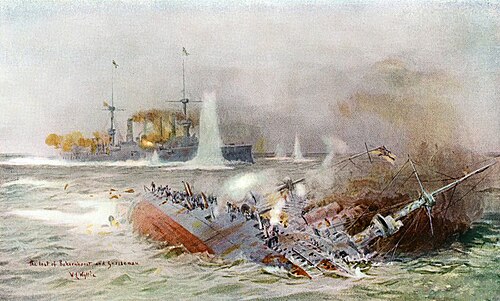
8 December 1914 · South-east of the Falkland Islands
Battle of the Falkland IslandsDecisive British victory
Spee came to raid Port Stanley and found two battlecruisers coaling there, sent south after Coronel. In the long chase that followed, the battlecruisers sank Scharnhorst and Gneisenau while the cruisers hunted down Nürnberg and Leipzig. Spee and both his sons were among about 1,900 German dead. Only Dresden escaped.
9
vs
8 (6 lost)

13 December 1914 · Sarı Sığlar Bay, inside the Dardanelles
Sinking of MesudiyeBritish success
The small, old submarine B11 dived under the minefields guarding the Dardanelles and torpedoed the elderly Ottoman ironclad Mesudiye, a veteran of the Balkan Wars, at anchor. B11 got back out after nine hours submerged.
1
vs
1 (1 lost)
1915

24 January 1915 · Near the Dogger Bank, North Sea
Battle of Dogger BankBritish victory
Warned by codebreakers in Room 40, Beatty's battlecruisers caught Hipper's raiding squadron at dawn. In the long stern chase Blücher fell behind and was wrecked, and Seydlitz nearly blew up when a turret fire spread. Then Lion was disabled, and confused flag signals led the other British ships to finish off Blücher instead of chasing the rest, which escaped.
47
vs
26 (1 lost)

18 March 1915 · Dardanelles, below the Narrows
Attack on the Dardanelles NarrowsOttoman victory
The allies tried to force the Dardanelles with battleships alone. Sixteen battleships went in to silence the forts, but on 8 March the little minelayer Nusret had laid a line of mines in Eren Köy Bay where the fleet manoeuvred. The French Bouvet hit a mine and capsized in under two minutes; Irresistible and Ocean were mined and abandoned; Inflexible, Suffren and Gaulois were badly damaged. Admiral de Robeck called off the attack, and the army was landed at Gallipoli instead.
14 (3 lost)
vs
1

13 May 1915 · Morto Bay, Gallipoli
Sinking of GoliathOttoman success
On a foggy night the Ottoman destroyer Muavenet-i Milliye, with a German officer aboard, slipped down the straits and torpedoed the battleship Goliath, which was supporting the French troops ashore. Goliath capsized and about 570 men died.
1 (1 lost)
vs
1

25–27 May 1915 · Gaba Tepe and Cape Helles, Gallipoli
U-21 off GallipoliGerman success
Fresh from her long voyage from Germany, U-21 torpedoed Triumph off the Anzac beaches on 25 May and Majestic off Cape Helles two days later, in full view of the troops ashore. The allied battleships were withdrawn to harbour, and the army lost much of its heavy gun support.
2 (2 lost)
vs
1

2 July 1915 · Off Gotland, Baltic
Battle of GotlandRussian victory
Russian codebreakers read German signals about a minelaying sortie. Rear Admiral Bakhirev's cruisers caught the minelayer Albatross and her escorts in fog off Gotland; Albatross was set on fire and ran aground on the neutral Swedish coast. German cruisers came up and both sides broke off, short of ammunition, and the British submarine E9 torpedoed Prinz Adalbert. It is often called the first naval action decided by signals intelligence. (19 June in the Russian Old Style calendar.)
6
vs
5 (1 lost)

8 August 1915 · Sea of Marmara, off Bolayır
Sinking of Barbaros HayreddinBritish success
On her second patrol in the Sea of Marmara, E11 caught the old battleship Barbaros Hayreddin, the Ottoman flagship at Elli and Lemnos, on her way to support the defenders at Gallipoli, and sank her with a torpedo.
1
vs
1 (1 lost)

8–20 August 1915 · Irbe Strait and Gulf of Riga
Battle of the Gulf of RigaRussian defensive success
Hipper brought dreadnoughts and battlecruisers from the North Sea to force the Irbe Strait, destroy the old battleship Slava and mine the entrance to Moon Sound, to help the German army take Riga. The first attempt failed. The second broke into the gulf: Nassau and Posen fought Slava, and a German torpedo boat was lost in the minefields. But with British submarines about, and E1 having torpedoed Moltke, the Germans withdrew. Riga held until 1917.
4 (2 lost)
vs
3 (2 lost)
1916

31 May – 1 June 1916 · North Sea, off the coast of Jutland
Battle of JutlandDisputed: German tactical success, British strategic victory
The only full clash of battle fleets in the war. Scheer hoped to trap part of the Grand Fleet; Room 40's codebreakers sent the whole of it to sea. In the opening battlecruiser action Indefatigable and Queen Mary blew up. Beatty then drew Hipper and Scheer north onto Jellicoe's battleships, which twice crossed the German T. Scheer turned away under cover of torpedo attacks and slipped behind the British fleet in a confused night action. Britain lost more ships and twice as many men (about 6,100 to 2,550), but the High Seas Fleet never again seriously challenged British control of the North Sea.
151 (14 lost)
vs
99 (11 lost)
1917

15 May 1917 · Strait of Otranto, Adriatic
Battle of the Strait of OtrantoAustro-Hungarian tactical victory
The Otranto barrage was a line of armed drifters with anti-submarine nets across the mouth of the Adriatic. Three Austro-Hungarian scout cruisers under Miklós Horthy, disguised as British destroyers, raided it at night and sank 14 drifters, while two destroyers attacked an Italian convoy. Allied cruisers and destroyers caught the raiders on the way home and Novara was badly hit, but Austro-Hungarian reinforcements came out and the allies broke off. Dartmouth was torpedoed by a waiting U-boat.
53 (16 lost)
vs
5

16 October – 3 November 1917 · Moon Sound and the Gulf of Riga
Battle of Moon SoundGerman victory
Part of Operation Albion, the German invasion of the Estonian islands, fought while the Russian fleet was in revolutionary turmoil. The dreadnoughts König and Kronprinz broke into the Gulf of Riga and fought the two old Russian battleships, Slava and Grazhdanin, the former Tsesarevich, in Moon Sound. Slava was holed and scuttled in the channel. The Germans lost a torpedo boat and several minesweepers to mines, and two battleships were mined.
28 (2 lost)
vs
20 (8 lost)

17 November 1917 · Heligoland Bight
Second Battle of Heligoland BightIndecisive
British cruisers attacked German minesweepers working in the Bight. The German light cruisers covering them laid smoke and drew the British towards their minefields and two waiting battleships. Repulse set Königsberg on fire, a German shell killed Calypso's bridge crew, and when Kaiser and Kaiserin came up the British withdrew. One German minesweeper was sunk.
11
vs
6 (1 lost)
1918

20 January 1918 · Kusu Bay, Imbros
Battle of ImbrosBritish victory
With the British battleships away, Yavuz and Midilli came out of the Dardanelles and sank the monitors Raglan and M28 at Imbros. Heading for Mudros, they ran into a minefield. Midilli struck several mines and sank with most of her crew; Yavuz was mined three times and ran aground at the straits, where British aircraft bombed her for six days before she was towed off.
4 (2 lost)
vs
2 (1 lost)

23 April 1918 · Zeebrugge, Belgium
Zeebrugge RaidGerman success; canal blocked only briefly
Roger Keyes's plan to block the canal used by U-boats from Bruges. Vindictive landed storming parties on the long harbour mole to silence its guns while the submarine C3 blew a gap in the viaduct behind it. Three old cruisers filled with concrete were then to be sunk in the canal mouth; two got there, but not in quite the right place, and within days U-boats could pass at high tide. About 227 British were killed. Eight Victoria Crosses were awarded.
7 (5 lost)

10 June 1918 · Off Premuda island, Adriatic
Sinking of Szent IstvánItalian victory
Two Austro-Hungarian dreadnoughts were steaming south at night to join an attack on the Otranto barrage. Two small Italian motor torpedo boats on patrol found them. Luigi Rizzo's MAS-15 put two torpedoes into Szent István, which capsized about three hours later, filmed from a nearby ship. The attack on the barrage was called off.
2
vs
2 (1 lost)