Battles of the Napoleonic Wars
1803–1815 · 9 battles covered, in date order. Click a battle on the map for its summary.
Battle (size: ships engaged)
British movement
French movement
Routes are approximate.
1805

22 July 1805 · About 100 miles west of Cape Finisterre, Spain
Battle of Cape Finisterre (Calder's Action)British tactical victory; two Spanish ships taken, but Villeneuve got away
Coming home from the West Indies, Villeneuve's twenty ships of the line ran into Sir Robert Calder's fifteen, waiting for them off Finisterre. The battle was fought in fog so thick that ships could barely see their neighbours. The Spanish ships at the head of the Combined Fleet took the worst of it, and San Rafael and Firme, dismasted, drifted into the British line and were taken. Night ended the fighting, and for two days Calder, with damaged ships and his prizes to guard, did not attack again. Villeneuve went into Vigo and Ferrol, and then, instead of coming north to the Channel as Napoleon wanted, turned south to Cádiz. England was spared invasion, but the public expected another Nile. Calder was court-martialled and severely reprimanded for not renewing the fight, and missed Trafalgar.
16
vs
19 (2 lost)

21 October 1805 · Off Cape Trafalgar, Spain
Battle of TrafalgarDecisive British victory; 18 French and Spanish ships taken or destroyed
Ordered into the Mediterranean, and hearing he was to be replaced, Villeneuve sailed from Cádiz with 33 ships of the line. Nelson, with 27, had planned to break the enemy line in two places and destroy the centre and rear before the van could turn back to help. At dawn he formed two columns and bore down in light winds, flying the signal that England expected every man to do his duty. The leading ships took the enemy's fire for most of an hour before they could reply. Collingwood's Royal Sovereign broke through first, astern of Santa Ana; Victory passed close astern of Villeneuve's Bucentaure and raked her, then locked alongside Redoutable. A marksman in Redoutable's rigging shot Nelson through the shoulder and spine, and he died below three hours later, knowing he had won. Dumanoir's van turned back too late and mostly sailed away. Seventeen ships were taken and Achille blew up. A gale that night wrecked or sank most of the prizes, and four that had been taken were retaken or escaped into Cádiz; only four were brought into Gibraltar. About 4,400 French and Spanish sailors were killed and 2,500 wounded, the British 458 killed and 1,208 wounded. Napoleon had already marched his army away from the Channel, but Britain's command of the sea was not challenged again in the war.
34 (1 lost)
vs
39 (18 lost)

4 November 1805 · Off Cape Ortegal, north-west Spain
Battle of Cape OrtegalBritish victory; all four French ships taken
Rear-Admiral Dumanoir had escaped from Trafalgar with four ships of the van and was making for Rochefort when the frigate Phoenix found him and led Sir Richard Strachan's squadron to him. Strachan's four ships of the line and four frigates chased for a day and a half. His frigates caught up first and harried the French rear until the ships of the line came up on 4 November and engaged on both sides. After nearly four hours, with Dumanoir wounded and their ships badly cut up, all four French ships struck. The battle completed the destruction of the fleet that had sailed from Cádiz. All four prizes were taken into the Royal Navy; Duguay-Trouin, as HMS Implacable, lasted until 1949.
8
vs
4 (4 lost)
1806

6 February 1806 · Off Santo Domingo, Hispaniola
Battle of San DomingoBritish victory; the whole French squadron taken or destroyed
Two French squadrons got out of Brest in December 1805 to raid British trade. Vice-Admiral Leissègues took five ships of the line to Santo Domingo to land troops. Sir John Duckworth, who had left his station off Cádiz to chase the other squadron, followed him to the West Indies and found him anchored off the town. The French cut their cables and ran west along the coast, and Duckworth caught them within two hours. Alexandre, Brave and Jupiter were taken. The great three-decker Impérial and Diomède were run ashore at Nizao to escape capture and burned by British boats two days later. The British lost no ship. Duckworth's disobedience in leaving his station was forgiven.
11
vs
8 (5 lost)
1807

19 February – 3 March 1807 · The Dardanelles, Ottoman Empire
Dardanelles OperationOttoman success; the British squadron forced back through the Straits
With the Ottoman Empire drawing closer to Napoleon and at war with Russia, Britain sent Sir John Duckworth to force the Dardanelles and threaten Constantinople. The squadron had already lost Ajax to an accidental fire off Tenedos. On 19 February it ran up the Straits under the fire of the forts, and Sir Sidney Smith's division burned a Turkish squadron at anchor off Nagara Point. But the wind failed in the Sea of Marmara, and while Duckworth negotiated within sight of the city, the Turks, advised by the French ambassador, lined the shores with guns. Duckworth gave up and ran back down the Straits on 3 March. The forts fired stone shot weighing up to 800 pounds, and several ships were hit hard; the British lost about 200 killed and wounded on the way out. Nothing was gained.
11
vs
0 (11 lost)
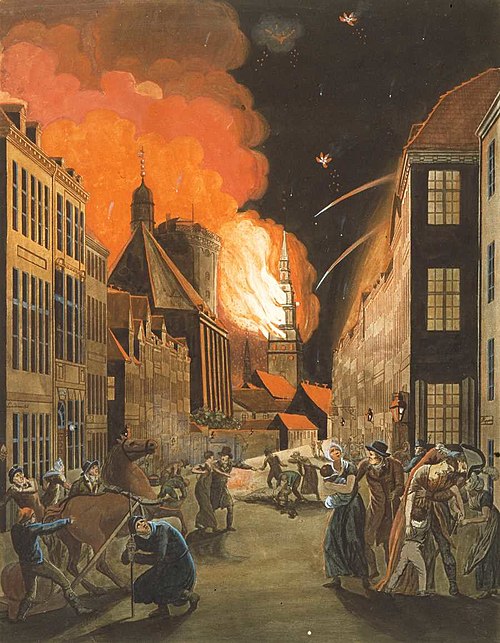
16 August – 7 September 1807 · Copenhagen, Denmark
Bombardment of CopenhagenBritish success; the Danish fleet surrendered
After the Treaty of Tilsit, Britain feared that Napoleon would seize neutral Denmark's fleet. When the Danes refused to hand it over for the rest of the war, Admiral Gambier's fleet landed an army under Lord Cathcart, with Sir Arthur Wellesley among its generals, and besieged Copenhagen. From 2 to 5 September the city was bombarded with mortars and Congreve rockets; a third of it burned and some 2,000 civilians were killed. The Danes surrendered on 7 September and handed over their fleet: 18 ships of the line, 11 frigates and many smaller ships. Those that could sail were taken to England. The attack drove Denmark into alliance with Napoleon, and the two countries fought a gunboat war in Danish waters until 1814.
1
vs
18 (68 lost)
1809

11–24 April 1809 · Basque Roads, off Rochefort, France
Battle of the Basque RoadsBritish victory; four French ships destroyed, but most of the squadron escaped
The French Atlantic squadron, blockaded in the Basque Roads off Rochefort, was anchored behind a boom under the guns of the Île d'Aix. The Admiralty sent the young Captain Lord Cochrane to attack it with fireships, against the wishes of the fleet commander, Lord Gambier. On the night of 11 April Cochrane led in explosion vessels and more than twenty fireships. They broke the boom, and although few reached the French ships, panic did the rest: almost every French ship cut her cables and ran aground. At dawn Cochrane signalled that the enemy could be destroyed, but Gambier held the fleet back for hours. Cochrane went in alone with Impérieuse, and only then were ships sent to help. Ville de Varsovie, Aquilon and Calcutta were taken and burned and Tonnerre was burned by her crew, but the rest got off on the tide. Cochrane, a Member of Parliament, said he would oppose the vote of thanks to Gambier. Gambier demanded a court-martial and was cleared, and Cochrane was given no more ships.
8 (23 lost)
vs
15 (5 lost)
1810

20–27 August 1810 · Grand Port, Mauritius (Île de France)
Battle of Grand PortFrench victory; four British frigates lost
The French frigates based on Mauritius had been taking East Indiamen for years, and the British were preparing to invade. Captain Nesbit Willoughby in Néréide had seized the island at the entrance to Grand Port when Commodore Duperré's squadron came back with two captured Indiamen and slipped into the harbour. Captain Samuel Pym brought in Sirius, Magicienne and Iphigenia to attack, but the channel through the coral was narrow and twisting and none of them had a pilot. Sirius and Magicienne ran aground before they could get into action, and Néréide grounded within range of the French ships. Néréide was fought until almost every man aboard was killed or wounded and Willoughby had lost an eye; she struck on the morning of the 24th. Sirius and Magicienne were burned by their crews. Iphigenia warped out, only to find Hamelin's squadron waiting at the harbour mouth, and surrendered. It was the only French naval victory of the war and is carved on the Arc de Triomphe. Four months later a British army took Mauritius and every ship in it.
4 (4 lost)
vs
8 (1 lost)
1811

13 March 1811 · Off the island of Lissa (Vis), Adriatic
Battle of LissaBritish victory; one French frigate wrecked and two Italian frigates taken
Captain William Hoste's four frigates used the island of Lissa as a base for raiding Napoleon's coasts in the Adriatic. Commodore Bernard Dubourdieu came across from Ancona with six French and Venetian frigates and smaller craft and about 500 troops to take it. Hoste hoisted the signal 'Remember Nelson' and formed a tight line. Dubourdieu copied Nelson's tactics and came on in two columns to break it, but Hoste held course close to the shore, and Dubourdieu's flagship Favorite, trying to board Amphion, was swept by grapeshot; Dubourdieu was killed and Favorite ran aground and blew up. Flore struck to Amphion but escaped before she could be taken; Corona and Bellona were captured. Hoste was badly wounded. The battle left the British in control of the Adriatic.
4
vs
6 (3 lost)